Balancing Rigor, Speed, and Business Value in UX Research with Cory Lebson | Episode #95
Cory Lebson explains how UX researchers balance rigor with speed, use AI carefully, connect studies to business goals, and partner with product teams.

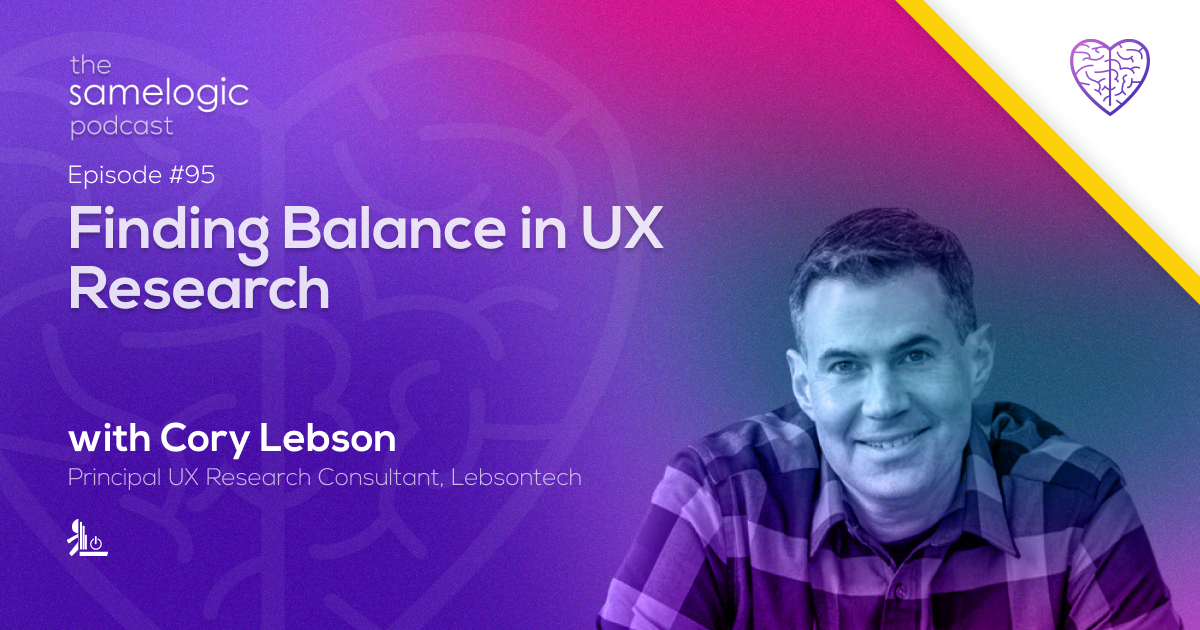
Cory Lebson has worked in UX research since 1994, when practitioners were more likely to be called usability specialists or human factors engineers and far fewer organizations employed them. The scale of the field has changed, but he says much of the underlying qualitative practice remains recognizable from what he learned in college and graduate school.
His route into the discipline began with an early interest in psychology. In 10th grade, he entered a Westinghouse Science Talent Search project about interpreting emotion through the color behind a person and became a runner-up. Later, a college research methods class held in a usability lab showed him how social science and technology could meet in one career.
In this conversation with Dwayne Samuels, Cory examines where AI helps and fails, how research earns business relevance, when rigor should give way to iteration, and what researchers and product managers need from each other.
What you'll learn
Why AI can support research work without replacing researcher judgment
How to begin with a business decision instead of a preferred method
When a study needs scientific rigor and when the team should fix a discovered problem immediately
Why researchers and product managers need flexibility and mutual respect
How community participation can support connection, learning, and career growth
Use AI as a research tool, not a synthetic participant
Cory warns against treating synthetic users as substitutes for usability studies with people. Experienced researchers bring accumulated judgment from prior studies, notice context, and interpret findings through more than a collection of reports. A generated participant cannot reproduce that expertise or the reality of a person's interaction with a product.
AI can still make useful contributions. Cory has tried general tools such as ChatGPT and Copilot as well as analysis products designed for market and UX research. He has used them to suggest possible interpretations of qualitative data and to help revise wording when creating a screener. The output can prompt a better idea without becoming the final analysis.
At the time of the interview, he had not found these tools to save time because he still needed to perform enough parallel analysis to check their accuracy. His standard is therefore practical: use AI to generate possibilities, but keep the researcher responsible for verification, interpretation, and decisions.
Connect research to the decision before choosing a method
For Cory, demonstrating research value starts during planning. A team should define the research question, the decision that the findings will inform, and the intended business or public outcome. A commercial study might support product improvement, market share, or competitive positioning. In his government work, the outcome may be whether members of the public can find the information they need.
This sequence prevents a familiar mistake: selecting a method first and looking for a reason to use it. Cory recommends starting with the end goal, then working backward to the appropriate approach. The preparation matters as much as conducting the sessions because it establishes how a finding could change the product or organization.
His consulting model also offers a discovery advantage. Because he often enters briefly to conduct a study, he may know only enough about the product to begin. He can identify himself as an outside third party and ask participants to explain the basics. Their explanations may expose a different understanding from the one stakeholders expected.
Rigor should match the consequences of the study. Medical-device research conducted for FDA approval may require a fixed, highly controlled protocol. A formative interview study does not need statistical significance to identify serious problems. If two participants reveal a flaw in a discussion guide, Cory may revise it. If several participants expose a clear usability problem, the team can fix that issue and use later sessions to test the remaining experience rather than waiting for all sessions to end.
Build a workable partnership with product and community
Cory's preferred relationship between research and product management is reciprocal. Product managers should understand what research contributes and avoid forcing every study into a two-week development window. Researchers should learn the product scope, design process, and business purpose rather than focusing only on executing a method. The goal is not maximum rigor at any cost. It is enough rigor to improve the product while preserving trust with stakeholders.
That balance also appears in his mentoring. Newer researchers may underestimate their abilities, introduce bias by explaining a design before asking for feedback, or pursue methodological perfection until stakeholders disengage. Cory advises asking neutral questions, managing talkative participants respectfully, and learning when to push back. He says finding the middle ground between being too accommodating and too rigorous took him about a decade.
He also encourages researchers, especially those working remotely, to participate in professional communities. He observed that many in-person meetups did not recover after the COVID period. His response is direct: attend available meetups and conferences, or create a local gathering when none exists. For independent researchers without regular colleagues, these connections can provide learning, career support, and simple contact with people doing similar work.
Continue with the workflow pages
Use the ideas from this episode inside the selector, Playwright, and bug-reproduction pages that connect content to product intent.
 Install the Chrome Extension