Episode #96: Learning, Growth, and Building Great Products with Robert Ta
Robert Ta explains how systems thinking, deliberate learning, strong teams, customer value, and empathy shape better product leadership today.

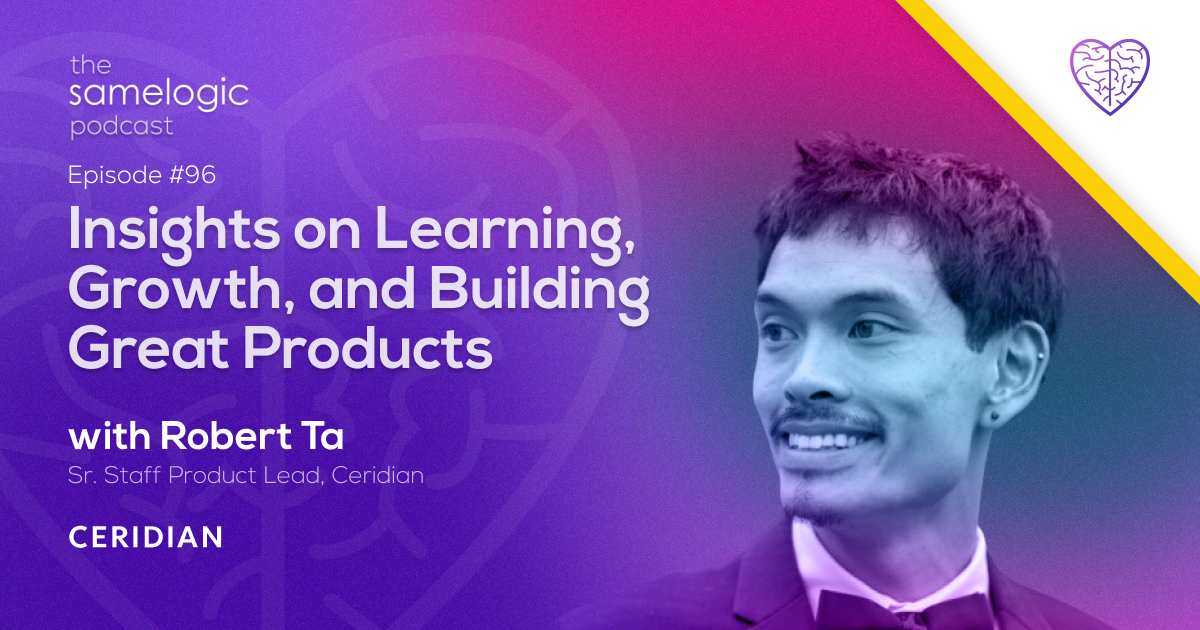
Robert Ta joins Dwayne Samuels to explain how a chemical engineering student became a product leader. His path was not a straight career plan. It developed through internships that showed him what he disliked about laboratory work, what he enjoyed about software, and how much he valued building products that improve people's experiences.
The conversation connects that transition to practical product work. Robert describes breaking complex systems into manageable problems, developing skills through focused practice, choosing teammates, learning from mentors, and prioritizing enterprise customer needs. He also reflects on how strengthening his emotional intelligence improved both his relationships and his ability to listen to customers.
What you'll learn
How chemical engineering trained Robert to define knowns, surface assumptions, and divide difficult problems into smaller parts
Why deliberate hours, focused attention, feedback, and repeated practice matter when entering a new domain
What Robert looks for when assembling a humble, hungry, and smart product team
How B2B product teams can connect customer requests to measurable business value
Why mentorship and empathetic listening can accelerate a product manager's development
Turn complex systems into manageable product problems
Robert chose chemical engineering after a high school chemistry teacher recommended it. Once he started the degree, he discovered that he enjoyed the mathematics, engineering, and thermodynamics more than laboratory work or organic chemistry. The discipline still gave him a durable way to think. A chemical system contains interconnected variables, known constraints, and important unknowns. His approach is to document what is known, make assumptions visible, identify which unknowns matter most, and then break the larger problem into solvable pieces.
An internship at Genentech helped redirect that thinking toward software. Robert worked with an internal global process-monitoring tool and traveled to interview stakeholders so their requirements could be implemented. A later internship gave him experience programming REST APIs and lightweight web clients for time-series monitoring. He was struck by the fact that work performed on a laptop could become useful software for other people.
Because he was paying his way through college, changing majors was not practical. He finished chemical engineering, studied programming independently, and entered Workday as an integrations consultant. That role combined customer conversations and requirements gathering with technical work connecting systems and managing data flows. After considering engineering and product management, he chose product because he wanted to influence decisions and build scalable products that improve users' journeys.
Build learning habits and teams that compound
Robert traces his work ethic to high school basketball. After failing to make the team in ninth grade, he practiced daily, made the team the following year, and later became a starter. The experience reinforced his belief that skills can be developed through intentional, high-quality practice. That mindset made unfamiliar domains such as HR, finance, gaming, developer tools, and cloud technology feel learnable rather than intimidating.
He applies a similar principle to team building. Product leaders cannot deliver meaningful products alone, so they must first identify the capabilities a problem requires and recruit people who can supply them. Robert favors teammates who are humble, hungry, and smart: low in ego, motivated to learn, and emotionally intelligent enough to collaborate. Leaders also need to understand how each person is influenced. Some respond to inspiration, others to rational evidence, assertion, negotiation, or a sense of shared purpose.
For product managers developing their craft, Robert recommends finding an experienced mentor and asking directly for time. He has seen newer PMs hesitate to approach a senior director, vice president, or chief product officer they admire. His advice is to bring a specific topic, request the conversation, observe how the expert approaches the problem, apply the feedback, and repeat.
Prioritize customer value and listen with empathy
Robert distinguishes consumer products from enterprise products before prioritizing feedback. A free game competes for attention, while HR software may be purchased to reduce payroll errors, improve payroll efficiency, increase recruiter efficiency, or support retention. In enterprise software, the buyer and daily user can also be different. A chief human resources officer may select the system, while employees experience it every day. Product teams need to understand both perspectives without treating every request as equally valuable.
His practical recommendation is to identify why customers buy the product, connect proposed work to that value, and favor high-value opportunities with reasonable effort. A team cannot cover every use case. It can address the common majority while making the product extensible enough for customers and ecosystem partners to solve more specialized needs. Frameworks such as RICE or Kano can organize the decision, but they do not replace a clear view of customer value.
Robert closes by discussing empathy, which he considers an earlier weakness that became a strength. Through years of therapy and work on identity, self-understanding, and relationships, he improved his emotional intelligence and empathetic listening. Those skills now help him hear customers more carefully, find meaningful problems, and assess product-market fit.
Continue with the workflow pages
Use the ideas from this episode inside the selector, Playwright, and bug-reproduction pages that connect content to product intent.
 Install the Chrome Extension