Growth Product Experiments for Self-Serve Onboarding with Chandrika Maheshwari | Episode #10
Chandrika Maheshwari explains how growth PMs improve self-serve onboarding, test buying hypotheses, and build trust into financial data experiences.

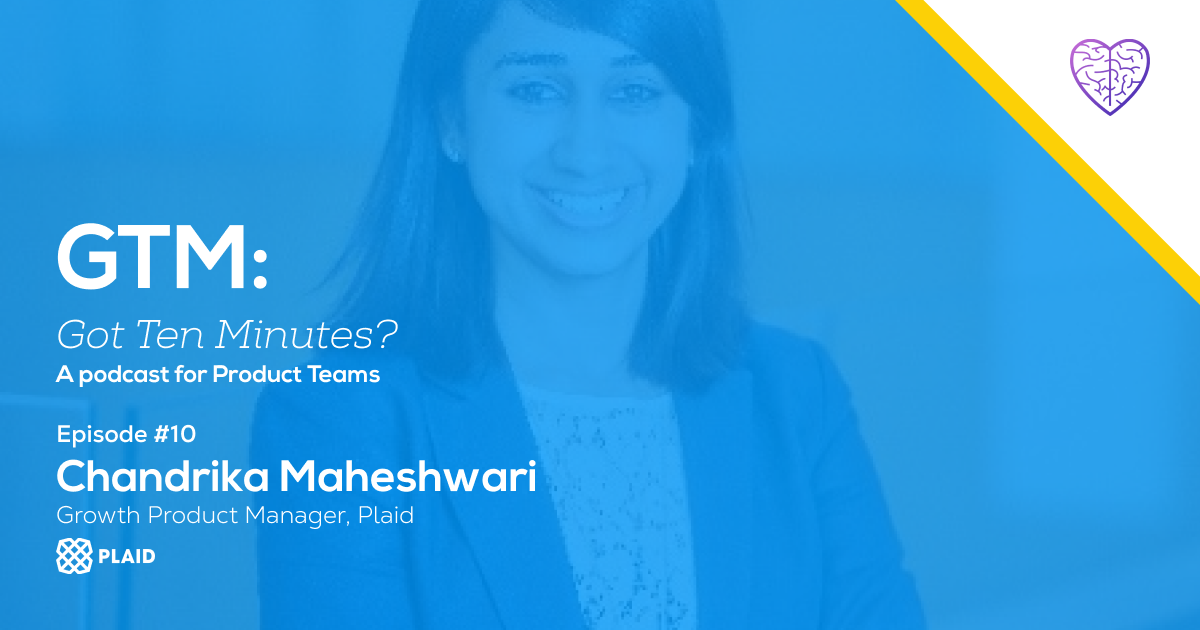
Chandrika Maheshwari reached product management by testing several career directions and paying attention to the work that held her interest. She began in management consulting, where she gained exposure to different industries, then moved into product marketing. Product marketing brought her closer to execution: understanding users, launching products, managing stakeholders, and seeing ideas come to life. Working alongside product managers showed her a role that combined a wide range of skills with the chance to solve meaningful problems for large groups of users.
Business school gave Chandrika a structured way to explore that interest. She worked as a product manager at Nike, decided she wanted to pursue the role full time, and joined DocuSign after graduating. After about two years there, she moved into fintech at Plaid. In this conversation with Dwayne Samuels, she connects those career steps to a practical growth-product challenge: helping customers understand a product, evaluate it, and buy it through a self-serve journey.
What you'll learn
How consulting and product marketing prepared Chandrika for product management
Why self-serve growth work spans product education, evaluation, trial, and purchase
How onboarding experiments can test which information helps buyers decide
How consent and data controls can support trust in a financial product experience
Design self-serve growth around the buying journey
Chandrika describes a common theme across her work at DocuSign and Plaid: enabling customers to self-serve. That goal is broader than removing a sales conversation. Customers first need to understand the product's value, then gain enough information and confidence to try it and eventually buy it. The product experience has to support each step.
Her experience at DocuSign therefore remained useful after the move to Plaid. Although the companies and products differ, both roles asked her to examine how customers progress from interest toward a decision. For a growth PM, the useful unit of analysis is not one screen in isolation. It is the sequence of questions a customer needs answered before moving forward.
A practical takeaway is to map that evaluation path before selecting an experiment. Identify what users need to understand at each stage, where uncertainty interrupts progress, and which product change could address that uncertainty. This creates a clearer hypothesis than simply trying to increase completion at the end of the funnel. It also keeps the experiment tied to customer comprehension rather than treating conversion as a purely numerical problem.
Test the information customers need to decide
Experimentation is one of Chandrika's favorite parts of product management. She describes forming a hypothesis, testing it, gathering insights, and then deciding whether to ship the change. Her Plaid experiments focused heavily on onboarding and on a specific question: what information is most helpful as users evaluate the product and reach a buying decision?
That framing gives product teams a disciplined way to improve onboarding. Instead of assuming that more explanation is always better, a team can test a defined change against a defined belief about user needs. The evidence then informs whether the change belongs in the product. A result is useful even when it does not support shipping, because it clarifies what did or did not help users move through evaluation.
For listeners running similar experiments, Chandrika's account suggests three checks. State the customer uncertainty the change is meant to reduce. Decide what evidence would support or weaken the hypothesis. Finally, connect the result to a shipping decision rather than allowing the test to become an isolated analytics exercise. The purpose is to learn enough to make a product choice.
Make trust visible in the product experience
Growth in financial technology makes trust part of the product journey, not a separate brand message. Chandrika says Plaid takes privacy and security seriously and works to help consumers understand and control how their financial data has been shared. Within the end-user experience, a consent pane explains who Plaid is and what it does.
She also discusses Plaid Portal, launched in 2019 as a central place for people to view and manage connections made through Plaid. Users can see which apps have access through those connections, control access, and request data deletion. These capabilities turn an abstract promise of control into actions a person can take.
For product managers, the broader lesson is to identify where trust depends on clarity and agency. Explain the participant that may be unfamiliar, show what data relationship exists, and provide controls that match the promise. In a sensitive flow, ease of use and reassurance should not depend on vague language. They should be reflected in understandable consent and meaningful control.
Listen to the full conversation with Chandrika Maheshwari:
Continue with the workflow pages
Use the ideas from this episode inside the selector, Playwright, and bug-reproduction pages that connect content to product intent.
 Install the Chrome Extension