AI Landing Pages and Bold Product Leadership | Episode #16 with Martin Lasarga
Martin Lasarga explains how continuous experiments improve landing pages, why engineers must resist solution-first thinking, and how PM mentors build confidence.

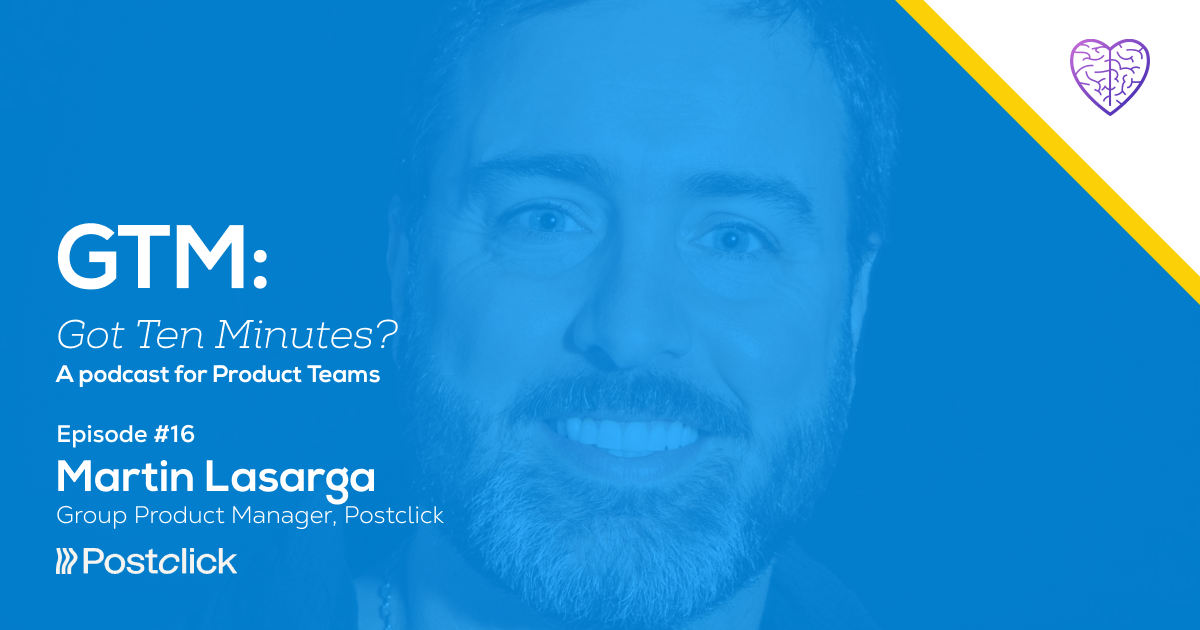
Martin Lasarga's route into product management began in engineering, but coding alone did not answer the questions that interested him most. After about three years as a developer, he moved into business analysis to understand how companies operate, make money, and deliver value. Product management then gave him a way to connect those concerns. His enduring framework is direct: decide what to build, why it matters, when to build it, and how success will be measured.
At Postclick, Martin applies that framework to landing-page optimization while also leading and mentoring product managers. The conversation covers a useful tension in technical product leadership: engineering knowledge helps a PM understand complexity and communicate with developers, but it can also create an instinct to jump to solutions before the problem is clear.
What you'll learn
How an engineering background can improve technical collaboration while encouraging premature solution design
Why Postclick continuously compares landing-page variants rather than treating optimization as a finished project
How adoption, engagement, and conversion evidence guide product decisions
Why mentoring PMs requires both sharing experience and leaving room for bold execution
How confidence and curiosity helped Martin move beyond overthinking and a comfortable career path
Turning experiments into continuous optimization
Martin describes experimentation at two connected levels. As a product manager, he compares multiple solutions to the same problem and watches adoption and engagement to determine what benefits the product. As a user of Postclick's own platform, he sees how customers test landing pages built with their original tools against pages produced by machine learning and AI systems.
The experiments can vary layouts, combinations of content blocks, and AI-generated content. The goal is not simply to declare one page a permanent winner. When one variant performs best, more layouts are already waiting to compete with it. That makes optimization a continuing cycle rather than a one-time release decision.
This approach also requires close cross-functional work. Martin points to the role of big-data and machine-learning teams in supplying the information needed for people, or the system itself, to make faster decisions. Product managers have to understand what information exists, what it means, and how it connects to the outcome that matters: a landing page that converts better for the customer.
The practical lesson is to begin with a defined problem, create meaningful alternatives, and establish the evidence needed to compare them. An experiment is valuable when it improves a decision, not merely because a team can run a test.
Leading PMs without removing ownership
Martin's transition into group product management changed his daily work. He mentors PMs, removes blockers, supports hiring, and coordinates with engineers, customer-facing teams, and leadership. The range of those responsibilities makes his days varied, but he identifies mentoring as both the hardest and most satisfying part.
The challenge is translating accumulated experience into something another PM can quickly use. Martin wants his team to learn from mistakes he has already made, yet he also wants them to act boldly and execute. Effective mentoring therefore cannot become a list of instructions that takes judgment away from the mentee. It should help PMs gain context, avoid avoidable errors, and still own their decisions.
Seeing colleagues and mentees grow their careers and skills gives Martin energy. His account also shows why technical fluency is useful at the leadership level. It makes it easier to investigate delivery complexity and understand engineering concerns, as long as the PM keeps returning to the problem rather than prescribing the implementation too early.
Confidence, curiosity, and the willingness to move
Martin connects his professional growth to becoming less shy, less comfortable, and less prone to overthinking. Moving from Uruguay to California with his family meant leaving a familiar job and a long-established comfort zone in search of new challenges. He presents that decision as evidence of a broader change in how he operates: act with more confidence, remain curious, and do not let fear of failure prevent movement.
That mindset fits the experimentation culture he describes at Postclick. Fast action is useful when teams can learn quickly, acknowledge failure, and apply the result to the next decision. Boldness without measurement would be recklessness, while measurement without action would become delay. Martin's story joins the two.
Listen to the full episode to hear how he connects continuous optimization, technical judgment, PM mentorship, and personal confidence.
Continue with the workflow pages
Use the ideas from this episode inside the selector, Playwright, and bug-reproduction pages that connect content to product intent.
 Install the Chrome Extension