Energy Ownership, Customer Feedback, and Empathy | Episode #21 with Parth Choksi
Parth Choksi explains Tesla energy ownership experiences, how data and support conversations guide products, and why empathy improves customer service.

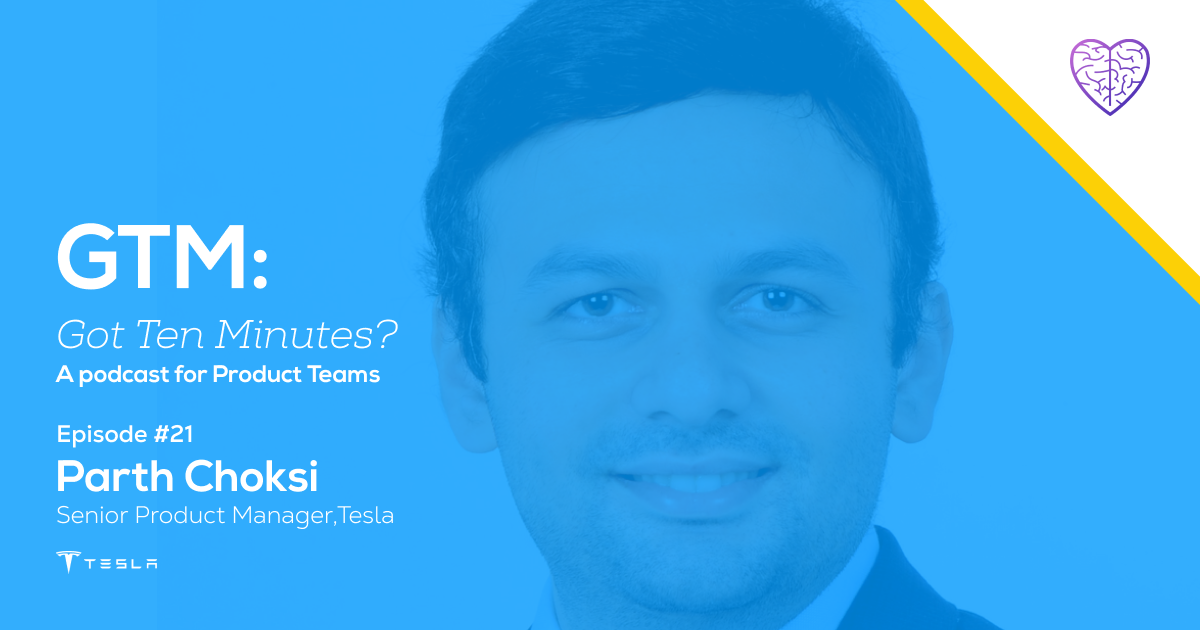
Parth Choksi came to product management through engineering, renewable energy, and entrepreneurship. Originally from India, he completed bachelor's and master's degrees in mechanical engineering and worked as a project engineer managing renewable energy projects, including solar projects. He then made a major shift by starting a company in virtual reality when the technology was unfamiliar enough that his team had to explain it to prospective users.
The startup built virtual reality training for construction safety and shop-floor safety. Parth ran the company for three years before it was acquired. During that experience, he realized that he enjoyed understanding users and solving their problems, which pointed him toward product management. He later moved to the United States for a master's degree in engineering management, worked with startups as a product manager, and joined Tesla in January 2021.
What you'll learn
How engineering, renewable energy work, and a virtual reality startup shaped Parth's path into product
What the ownership experience includes for Tesla energy customers after a purchase
How data and customer conversations help his team identify product opportunities
Why cross-functional collaboration matters across energy, hardware, vehicle service, and support teams
How empathy can reduce repetition and frustration when customers seek help
Designing the energy ownership experience
At the time of the conversation, Parth managed the ownership experience for Tesla's energy business. The products he names include solar panels, Solar Roof, Powerwall, and Wall Connector. His scope begins after a customer purchases a product and spans the Tesla app, the customer's account on the website, support pages, and the broader service experience.
Through the app, customers can interact with their energy products, change settings, review performance, see how much energy they are generating, and track energy saved to a Powerwall. When something goes wrong, they also need a clear way to connect with Tesla. Parth's role is to help customers solve problems, whether that means guiding them through a simple action themselves or making support available when self-service is not enough.
That responsibility also connects his team to new product work. Core product teams experiment with hardware and other innovations. Once an effort reaches a stage where customers may need ownership and support experiences, Parth's team becomes involved. It prepares ways for customers to contact Tesla and looks for opportunities to let customers resolve problems on their own.
Combining data, feedback, and collaboration
Parth describes two frequent inputs to product improvement. The first is years of data about common problems customers face. The second is listening to users, including conversations between customers and support agents. The data shows patterns, while the conversations offer deeper insight into how customers think and approach a situation. He says combining the two has been his most useful way to improve how customers interact with Tesla.
Feedback arrives directly and indirectly. Customers may explain that something works or that a feature is difficult to use. Customer support then relays relevant observations to product teams. The response depends on the feedback. A bug or urgent problem may require a quick fix, while an unexpected use of a feature can reveal that customers are gaining value in a way the team did not anticipate.
The team captures feedback in databases, visualizes it in dashboards, and uses those views to see where feedback is concentrated before examining the details. Agile practices and Jira support ticket tracking and follow-through. Parth does not present this as a special named framework. The practical system is to capture, visualize, investigate, prioritize, and act.
Cross-functional work is equally important. Parth collaborates with the teams that design and build Tesla's energy hardware, as well as the vehicle team responsible for vehicle service and support. Learning from vehicle service and understanding the underlying energy products both help him make decisions about the ownership experience.
Prioritizing with empathy
One of Parth's daily challenges is balancing the needs of different customer segments and demographics. After identifying those needs, he has to prioritize solutions so that groups do not feel neglected and the result serves most, if not all, customer segments. The satisfying counterpart is hearing that a customer's problem was solved or that a support agent found a feature useful.
Parth identifies user empathy as a former weakness that he deliberately developed into a strength. He now tries to experience a process from the user's point of view while also considering the people who support that user. His example is continuity during support: if a customer has already completed and recorded troubleshooting steps, the agent should be able to see that history rather than asking the customer to repeat the work.
That example connects the episode's themes. Good ownership experiences rely on accurate data, attentive listening, coordination across teams, and respect for the customer's time. Listen to the full episode to hear Parth explain how those practices shape product management for Tesla's energy customers.
Continue with the workflow pages
Use the ideas from this episode inside the selector, Playwright, and bug-reproduction pages that connect content to product intent.
 Install the Chrome Extension