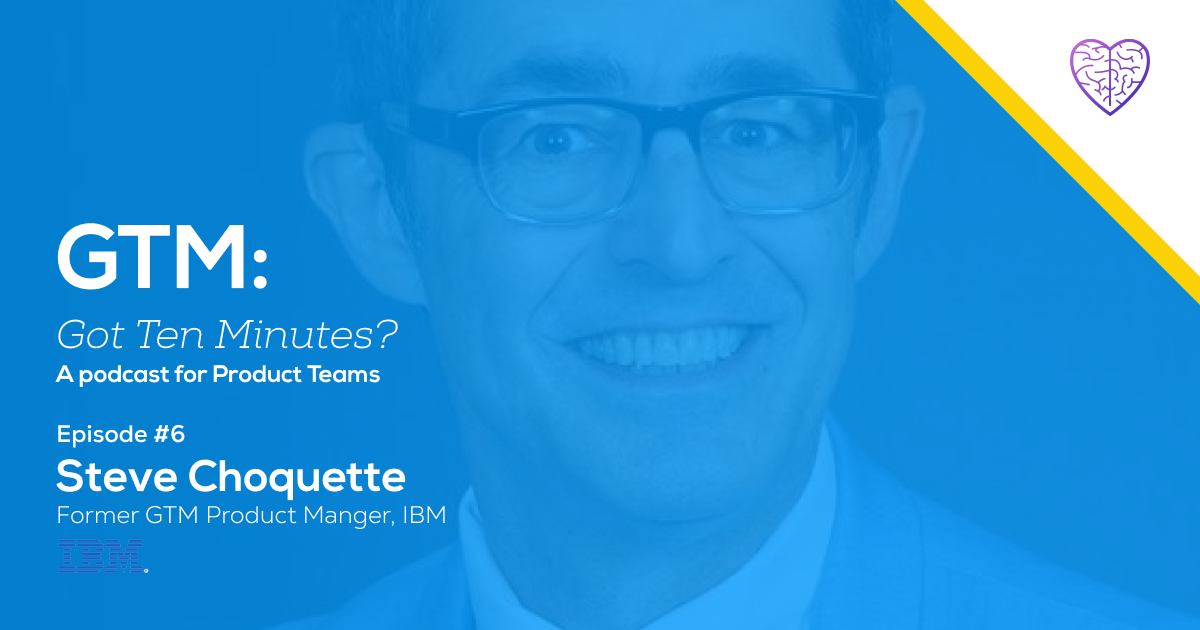
Episode #6: Seeing the Whole Product with Steve Choquette, Part 1
Steve Choquette reflects on four decades at IBM and explains how product managers can find patterns, see the whole, and build lasting relationships.

A product manager can spend so much time refining features that the customer's real problem fades from view. In Part 1 of our conversation, Steve Choquette shares a practical counterweight: step back, find the pattern, and manage the whole product.
What you'll learn
How varied roles can strengthen a product manager's big-picture judgment
Why customers and business partners experience a whole solution, not isolated features
How bringing order to ambiguity can turn a messy situation into a workable sequence
Why long-term professional relationships may matter more than any single launch
A career shaped by change
Steve describes a 41-year career at IBM that began in programming and moved through release management, development management, people management, strategy, business operations, and product management. His first assignment involved a sonar training system in IBM's Federal System Division. The work was performed on a UNIVAC machine, not an IBM computer, an early reminder that a career rarely follows a perfectly tidy path.
A transfer to Raleigh brought another memorable lesson in adaptability. Steve was asked whether he could spend substantial time in Kingston, New York. On arriving at his hotel, he answered the standard checkout question by asking for the date seven weeks later. That story captures the scale of commitment and change that ran through his working life.
The market changed just as dramatically. Steve recalls an earlier era with relatively few major computing competitors and a business model in which customers paid for hardware while software came with it. By the time he left IBM, software had its own value, competition had expanded, and the internet, cloud, mobile technology, and AI had widened what companies could build. For product teams, the lesson is not nostalgia. It is that assumptions about customers, competitors, and value must keep moving with the market.
Turning chaos into a sequence
Steve says he enjoys looking at a mess and pulling out a strategy, flow, and plan. He compares the process to sorting a scattered pile of candy by color until the underlying pattern becomes visible. The useful part of that image is not simply organization. It is sequencing: deciding what the team needs to do first, what follows, and how the plan should change through completion.
That habit can help us handle ambiguous product work without pretending uncertainty has disappeared. A roadmap is not just a list of features. It is an evolving explanation of how the pieces fit together and why the order makes sense. When teams face a crowded backlog, conflicting inputs, or a shifting market, the first task may be to identify the pattern before choosing the next feature.
Steve connects this skill to his strategy experience. Strategy and product management both involve roadmaps, markets, and the larger context around the work. Moving through different roles helped him see beyond a narrow functional view and understand how the parts combine.
Customers see the whole
One of Steve's clearest cautions is that product managers can become absorbed in one, two, or three exciting features. Customers and business partners do not experience our internal enthusiasm or the boundaries in our backlog. They see the complete offering and judge whether it addresses their business problem.
For a product team, this suggests a simple review habit. Before debating another feature, restate the customer's full problem and inspect the experience from beginning to end. Ask whether the proposed work improves that whole or merely optimizes one component. Feature quality matters, but it needs to support a coherent outcome.
Build work that lasts through relationships
When asked what he was proudest of building, Steve did not begin with software. He chose relationships. For 21 years, he recruited at Virginia Tech and stayed connected with students as their careers took them to customers, partners, and competitors. One former student, Brian Sebastian, told Steve that he still carried Steve's 2012 business card in his wallet.
That story broadens the definition of product impact. Products change, roles end, and markets reorganize, but thoughtful professional relationships can continue across companies and years. Part 1 leaves us with a grounded product practice: find order without losing flexibility, evaluate the complete customer problem, and value the relationships formed while doing the work. Listen to Episode 6 to hear Steve's stories and product lessons in full.
Continue with the workflow pages
Use the ideas from this episode inside the selector, Playwright, and bug-reproduction pages that connect content to product intent.
 Install the Chrome Extension