Experiment-Led Product Timing with Adam Cheyer | Episode #8
Adam Cheyer explains how instrumentation, rapid experiments, trend forecasts, and trigger events help product teams find the right idea and launch window.

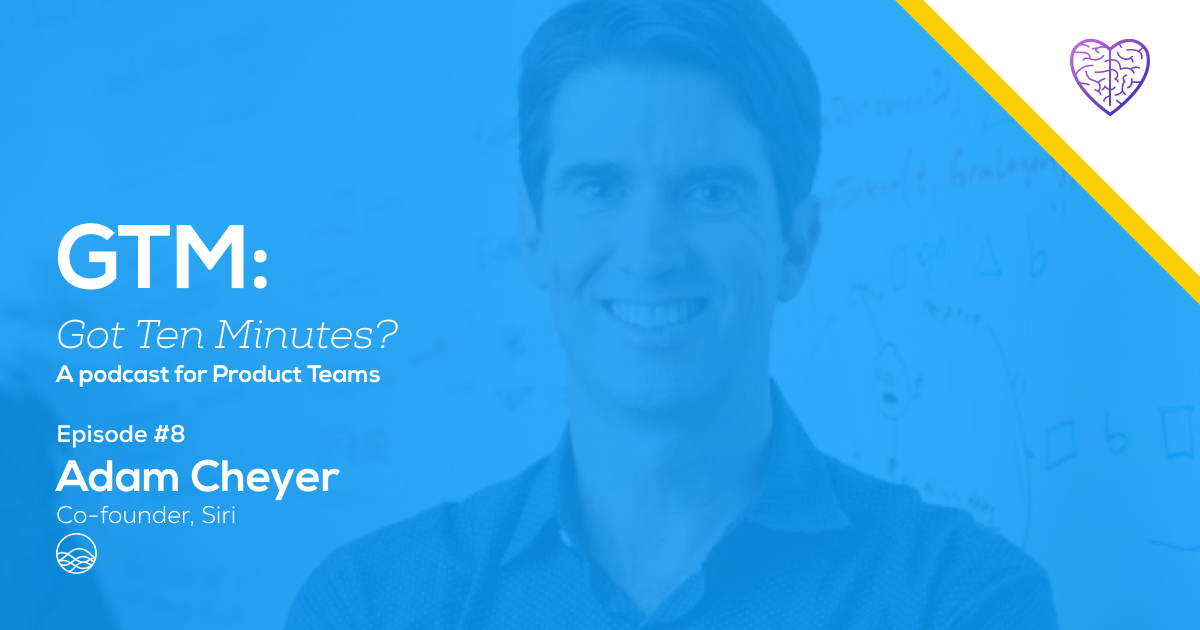
Adam Cheyer has spent years exploring how emerging technology can become a useful product at the right moment. In this episode, the co-founder of Siri examines two questions that matter to product teams: how do you discover which part of a broad vision users actually value, and how do you decide when the market is ready for it?
He draws on Change.org's broad experimentation and Siri's long-running assistant vision to show how product discovery connects with go-to-market timing.
What you'll learn
How detailed instrumentation can reveal which product behavior deserves more investment
Why rapid iteration is more useful when experiments remain aligned with a larger vision
How to form trend hypotheses before the market direction is obvious
What makes an external event a meaningful trigger for product development
How a market trigger can translate into a specific customer task and interface
Instrument broadly, then follow the strongest signal
Cheyer describes Change.org as Ben Rattray's idea for a social network focused on social activism. The team began in 2006, when social networking was accelerating, but it did not know which feature would become the central product. Cheyer built the first minimum viable product, and friends joined on a volunteer basis to help develop it.
Instead of treating the initial concept as a finished answer, the team instrumented the experience. It tracked what people clicked, what they did, and how long they spent with different parts of the site. That visibility supported rapid iteration across many ideas. The team tried a political feature that let people call a local member of Congress, a giving platform built around cause-related gifts, and a job board for work connected to social causes.
Petitions performed somewhat better than the alternatives, so the team expanded their role in the product. Cheyer recalls growth holding around one million users during the early years before rising to 10 million, 25 million, and beyond. At the time of the conversation, he says the platform had more than 400 million members.
The useful lesson is not to follow every metric mechanically. Cheyer pairs data with direction: maintain a vision, observe what is working, and invest when the signal also moves the product toward that vision. For a product team, that means defining the behaviors that indicate value before running experiments, instrumenting those behaviors, and giving a stronger signal enough space to become the product's focus.
Separate long-term trends from market triggers
Cheyer's timing framework has two parts: trends and triggers. A trend is a reasoned view of where the world is moving. In 2004, which he viewed as the web's tenth anniversary, he made ten predictions for the following ten years. He recommends choosing an unsettled topic, researching it, and developing an opinion rather than waiting until the outcome is obvious.
Three of his predictions became especially important to his company building. He expected social networking to grow, data to move into the cloud and make machine learning more important, and a new mobile interface to emerge around a Siri-like assistant. These were directional beliefs, not proof that a particular product should launch immediately.
A trigger is the external event that makes one of those beliefs actionable. For Cheyer, the arrival of the iPhone was that event. While some observers doubted that a company outside the established phone industry could succeed, he saw the device as a signal that the industry would be disrupted and competitors would urgently need new ways to respond.
This distinction helps teams avoid two common timing errors. A trend without a trigger can lead to launching before the supporting market exists. A trigger without a prior point of view can leave a team reacting too slowly. Product leaders can prepare by documenting their highest-conviction trends, identifying events that would strengthen or weaken each belief, and deciding what they would build if a trigger appeared.
Convert the trigger into a customer advantage
Cheyer did not stop at predicting that smartphones would reshape the market. He examined the constraints of the early mobile experience. Screens were small, typing was difficult, and 3G connections made repeated interactions slow. A useful assistant could let someone state a complete task, such as finding and booking a nearby restaurant for a specific time and party size, and complete it with one request rather than many clicks.
That reasoning turns market timing into product design. First identify the industry shift. Then ask which new pressure it creates, who will feel that pressure, and what customer experience could create an advantage. In Siri's case, the trigger suggested both a market need and an interface suited to the limitations of the moment. Apple ultimately moved first by acquiring Siri, but Cheyer's broader point is about preparation: a team with an informed trend hypothesis can interpret a trigger, anticipate what the market will need next, and build toward that need before the window closes.
Listen to Episode #8 for Cheyer's complete discussion.
For product managers, the operating model is concrete: instrument the vision, test several expressions of it, follow the evidence that aligns with the mission, and prepare in advance for the event that turns a plausible future into a timely product opportunity.
Continue with the workflow pages
Use the ideas from this episode inside the selector, Playwright, and bug-reproduction pages that connect content to product intent.
 Install the Chrome Extension