Gamifying Physical Therapy through User Research with Aditya Rao | Episode #43
Aditya Rao explains how double-diamond discovery, rapid prototypes, and careful user selection shape accessible, gamified physical therapy experiences.

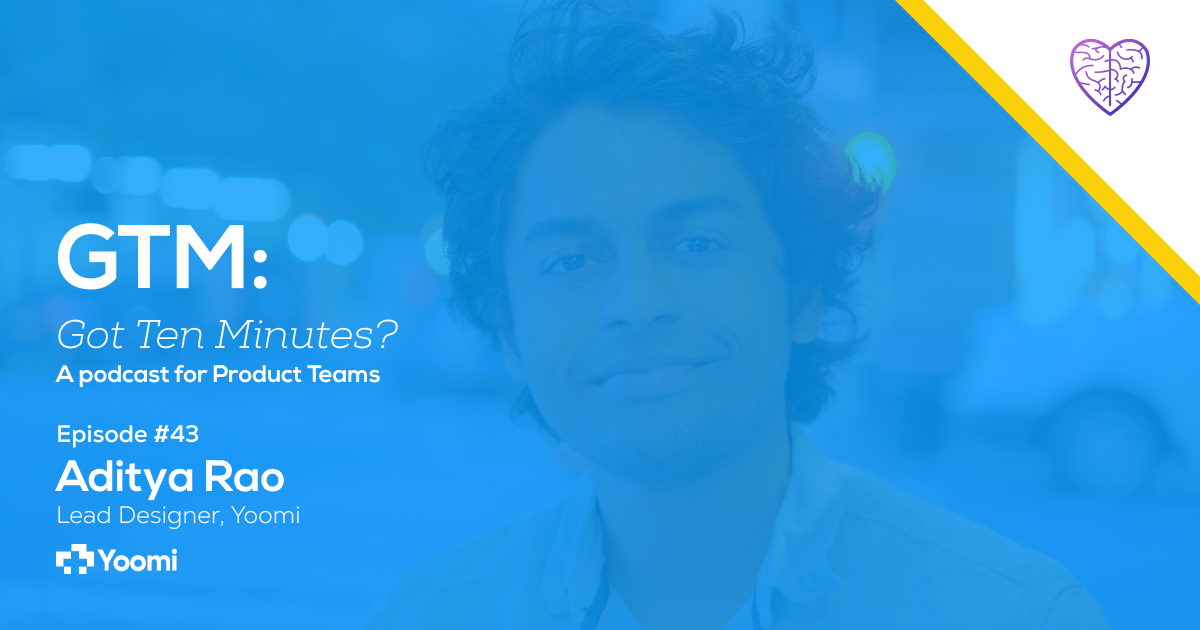
Aditya Rao discovered design in a high-school wood workshop. A teacher introduced the double-diamond approach, giving him a structured way to move from an ambiguous problem through research, synthesis, prototypes, and testing. He later studied industrial product design in India and gained experience across graphic, service, and experience design.
As Lead Designer at Yoomi, Aditya worked on software intended to make physical therapy exercises more engaging. The system used a camera to map a patient's skeletal structure and joints, then connected prescribed movement to a game experience. His conversation with Dwayne Samuels examines how a young healthcare product can identify the right users, test game mechanics, guide a design team, and avoid confusing a designer's attachment with evidence of value.
What you'll learn
How the double-diamond process creates room to diverge and converge
How physical movement can become input for a game-based therapy exercise
Why user selection is especially difficult across a wide patient age range
Which prototype details can be tested before a complete healthcare product exists
How leaders balance team members' interests, strengths, and product needs
Use divergence to clarify the problem
Aditya describes the double diamond as two cycles of expansion and focus. A team starts with a problem statement, then broadens its view through primary and secondary research, possible user groups, and relevant factors. It converges by synthesizing those findings into a clearer direction. The second diamond expands again through prototypes and iteration, then narrows toward a design ready for rollout.
The framework helps designers operate with ambiguity without rushing to the first plausible answer. Project length can change the amount of time available, but the logic remains useful: explore the space, identify evidence, build alternatives, break them, rebuild them, and test.
That mindset also challenges professional identity. Aditya once expected to remain an industrial designer, but work across other design fields taught him to change hats. The product problem should determine which methods and skills matter, not the label a designer wants to preserve.
Test the game around the patient
Yoomi's concept maps body movement through a camera so a patient can interact with an exercise on screen. Aditya uses a Pong-style example: raising an arm could control a paddle, turning the prescribed motion into play. The game supplies feedback and rewards while the physical therapist still determines the exercise.
Designing this experience means accounting for potential patients from around age 10 to 70 and older. Before comparing polished features, the team has to determine which user segments to speak with and what games make sense for them. A popular interaction for one age group may be unfamiliar, inaccessible, or unmotivating for another.
The team can then create a small looped prototype to test specific game properties. Aditya identifies element speed, color, and navigation as examples. Watching a person interact can reveal whether motion is too fast, visual choices cause confusion, or the flow is difficult to understand. A/B testing can compare two versions of a similar feature, but it follows the more basic work of selecting an audience and deciding which aspect of the experience needs evidence.
Healthcare adds further constraints. Aditya notes the need for clearances in the medical space and the difficulty of finding the right testing method, sample size, pace, and participants. Research takes time away from making screens, yet weak or dishonest data can send the product in the wrong direction. The goal is not maximum research. It is enough credible research to support the next decision.
Lead without designing for yourself
As a lead, Aditya worked with management on product features, game concepts, user definition, and testing while mentoring a younger design team. One leadership challenge is matching what people enjoy with what they do well and what the product currently needs. A teammate may be interested in one activity but have a stronger skill in another. The leader has to respect the person while still aligning work with product goals.
Aditya also emphasizes shedding assumptions when meeting users. Designers embed part of themselves in what they make, which can create a false sense of ownership. A product is not for its designer. Releasing that attachment makes it easier to learn from people who will use it over time.
His own recurring weakness is difficulty letting go of completed projects. He now channels that concern into doing his best on the current work, then uses that confidence to move forward rather than repeatedly revisiting the past.
Listen to Episode #43 for Aditya's full conversation with Dwayne Samuels.
Continue with the workflow pages
Use the ideas from this episode inside the selector, Playwright, and bug-reproduction pages that connect content to product intent.
 Install the Chrome Extension