Episode #46: Designing Holistic Startup Experiences with Kadie O'Malley
Kadie O'Malley explains holistic experience design, practical B2B research, technical collaboration, and alignment inside a growing startup.

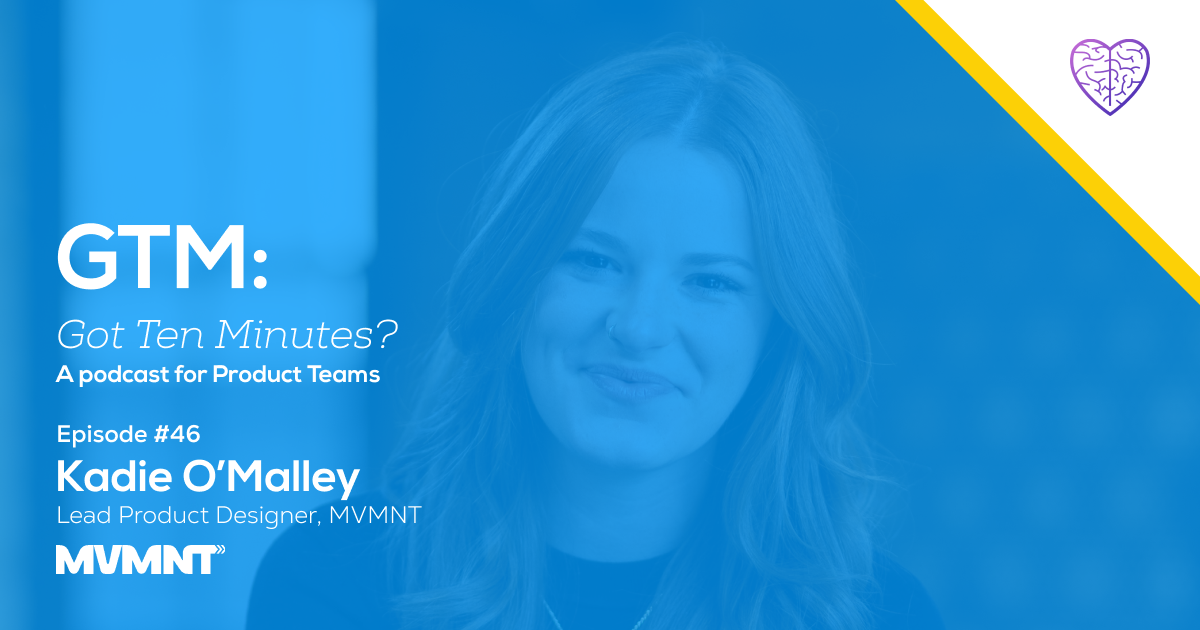
Kadie O'Malley's route into product design joined creative work with technical study. A strong graphic design program introduced her to digital art in high school. At Indiana University, she discovered informatics through a general education course and found a field where she could stay creative while learning how technology works. She later entered technical consulting, realized that the work was not as fulfilling as she hoped, and returned for a master's in experience design focused on how people interact with technology.
That combination now shapes her work as Lead Product Designer at MVMNT. In this conversation with Dwayne Samuels, Kadie explains how a startup designer can examine the complete customer experience, learn from users in a specialized B2B market, communicate with engineers, and keep teams aligned from research through implementation.
What you'll learn
Why a holistic experience begins before a customer enters the product
How a B2B startup can test ideas when outside participants are difficult to recruit
Why technical fluency improves collaboration between design and engineering
How storytelling helps product, design, engineering, and leadership reach alignment
What changes when a designer owns a product rather than rotating among consulting clients
Follow the customer beyond the interface
Kadie distinguishes product interaction from the larger customer lifecycle. A conventional UX or UI view might begin when someone first uses a screen. Her experience-design view starts with the person's first touchpoint with the company. She wants to know how that moment feels, what the customer expects, what might prevent them from finding the company, and how those early impressions connect to long-term loyalty.
That wider lens is relevant at MVMNT, which builds a free transportation management system for freight brokerages. Brokers connect people who have goods to ship with carriers and truck drivers. MVMNT's stated focus is helping small and midsize brokerages compete with larger businesses by giving them useful technology. Understanding that work requires more than polishing isolated screens. The design team has to consider how customers discover the company, evaluate the service, learn the software, and use it to support daily operations.
Startup work also gives Kadie broader ownership than consulting did. Her days can include customer research, coordination with marketing and sales, prototype development, and detailed work with engineering to make sure the implemented product matches the design intent. She values staying with one product and believing in the problem it addresses, even though the startup's many-hats environment will change as the company grows.
Use the evidence available in a specialized market
Kadie treats an experiment as any method that helps her learn enough to make a better design decision. That may be a usability test of whether someone can complete a flow, a comparison of alternatives, or direct customer research. Her preferred research activity is interviewing customers because it reveals what they are experiencing and how they think about their work.
Recruiting can be difficult in a specialized B2B market, so MVMNT uses several evidence sources. People inside the company often have experience similar to the target user and can provide an early round of testing. If an idea survives that stage, the team can build a prototype and take it to product advisory board members or customers with whom it has strong relationships. Internal feedback is not treated as the final word. It is an accessible first check before asking people closer to the real operating context.
This approach is practical rather than method-driven. The question is not which research technique is most impressive. It is what the team needs to learn, which participants can answer it, and how the evidence will improve the product decision.
Build alignment through fluency and story
Kadie's technical background helps her discuss databases, API calls, and implementation concerns with engineers. She uses that knowledge to understand their pain points rather than make their work harder. Consulting added another useful skill: exposure to different client environments, company cultures, successful projects, and projects that did not go as planned. Each experience offered material for deciding what to repeat or change.
Her recurring challenge is alignment. Product, engineering, design, business partners, and leadership can hear the same concept differently. Reaching consensus requires conversations, relationships, attention to communication styles, and timely questions. Kadie identifies storytelling as a strength because a clear story can take people from research through the reasoning behind a decision and help them follow the movement from one step to the next.
Listen to Episode #46 for Kadie O'Malley's account of holistic design, practical research, technical collaboration, and startup ownership.
Continue with the workflow pages
Use the ideas from this episode inside the selector, Playwright, and bug-reproduction pages that connect content to product intent.
 Install the Chrome Extension