Episode #50: Validating Product Demand with Fake Doors and Tasneem Muchhala
Tasneem Muchhala explains how fake-door tests, microsurveys, careful placement, and disciplined prioritization reveal genuine product demand.

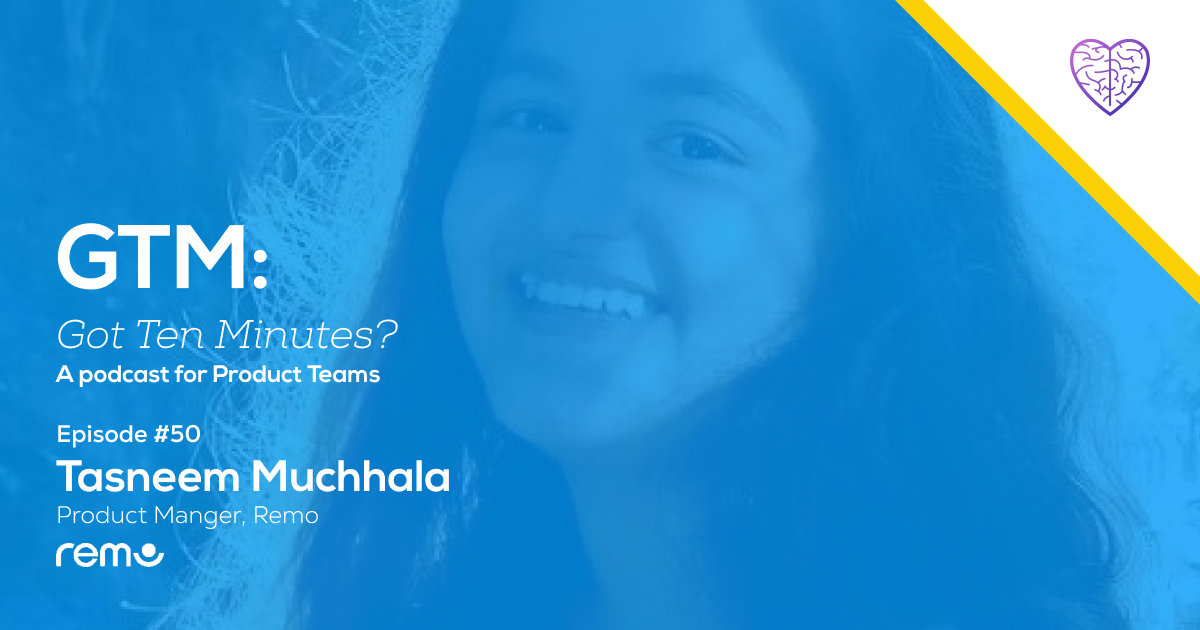
Tasneem Muchhala studied marketing and management expecting to enter marketing, human resources, or another business role. After university, she joined the customer success team at Remo, a virtual events startup. Daily conversations showed her what customers were trying to accomplish, how they used the product, and where they struggled. When she discovered product management, it connected the creativity and problem solving she enjoyed with the parts that had felt missing from her earlier work.
She later moved internally into a product manager role. In this conversation with Dwayne Samuels, Tasneem explains how fake-door experiments can test demand before a team commits engineering time, why a click needs qualitative context, and where not to place an experiment.
What you'll learn
How customer success experience can prepare someone for product management
Why fake-door tests measure behavior before a feature exists
How a microsurvey can explain the motivation behind a click
Why experiment placement matters inside a user's journey
How failed demand tests help product managers protect the roadmap and say no
Test behavior before building the feature
Remo was designed to make online events and meetings more interactive than a one-to-many presentation. Participants could move among small-group conversations, answer questions or polls in real time, and interact more naturally with one another. As a product manager in a startup, Tasneem faced a continuing stream of new problems, ideas, and requested capabilities.
A fake door offered a way to test one of those ideas before implementation. The team could place a button or entry point for a proposed capability inside the live application, then measure whether people tried to use it. Tasneem initially found the method strange because the button did not lead to a finished feature. Seeing the results changed her view. Instead of investing roughly two to four weeks building an assumption, the team could first observe whether the option attracted meaningful interest.
She describes fake doors as a direct test of whether a proposed feature appears valuable in context. Tools can reduce the engineering effort needed to run the experiment, which makes the method especially useful when a team needs an early demand signal rather than a complete product.
Pair every click with a useful question
A click alone does not reveal intent. Someone might be exploring the interface, clicking out of curiosity, or genuinely trying to complete a task. Tasneem's team pairs a fake door with a microsurvey that appears after the interaction. It can ask why the person selected the option or what they expected to accomplish.
This pairing creates quantitative and qualitative evidence. The click rate shows how often the behavior occurred. The response helps explain what was happening in the user's journey and whether the proposed feature addressed a real need. Tasneem recommends open-ended questions because they let people describe their motivations without forcing them into the team's assumptions.
The follow-up matters for prioritization. Customer requests can make an idea sound certain, especially when several people ask for the same feature. Tasneem saw fake-door results contradict what customers had said they wanted. Those outcomes saved the team from putting low-value work on the roadmap merely because the request sounded persuasive.
The lesson is not that stated feedback is useless. It is that a product manager should compare what people say with what they do, then investigate why the signals differ.
Protect the user's core task
Fake doors can frustrate people if the experiment interrupts an important goal. Tasneem advises teams to understand who the users are and where they are in the journey before placing a test. A fake button should not sit in the middle of a core flow when someone has arrived with a specific task, particularly if the person is under time pressure.
That guidance turns experiment design into an experience-design decision. The team has to learn without making the product feel unreliable. Placement, timing, audience, and the message after the click all affect whether the test is appropriate.
A useful fake door therefore has a bounded question. It appears in a relevant context, avoids obstructing essential work, collects an explanation after the click, and supplies evidence that can change a roadmap decision. If the team would build the feature regardless of the result, the experiment is not serving its purpose.
Ask why and learn to say no
Tasneem names saying no as one of product management's hardest responsibilities. Customers and colleagues bring creative ideas, and it is tempting to accept all of them. The product manager has to decide whether an idea supports the current business objective, belongs in a later period, or should not be prioritized.
Her nontraditional route into product became an advantage here. Because she did not assume she was the smartest person in the room, she became comfortable asking why, learning from teammates, and breaking a problem into smaller parts. Fake-door tests extend the same habit into the product: ask what people are trying to do, observe the behavior, and let evidence challenge the apparent answer.
Listen to Episode #50 for Tasneem Muchhala's practical account of fake-door testing, microsurveys, experiment placement, and prioritization.
Continue with the workflow pages
Use the ideas from this episode inside the selector, Playwright, and bug-reproduction pages that connect content to product intent.
 Install the Chrome Extension