Episode #56: Asking Better UX Questions with Jeff Appel
Jeff Appel explains how curiosity, humility, jobs-to-be-done thinking, and persistent questions help designers solve complex product problems.

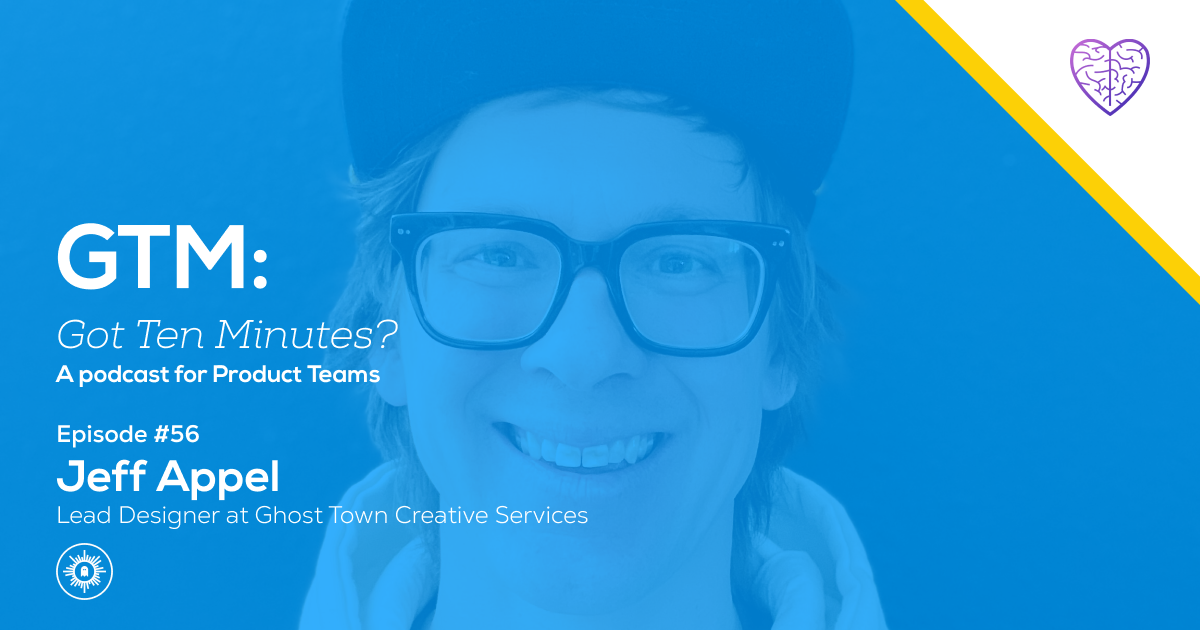
Jeff Appel entered UX through writing, philosophy, and a willingness to start again. Around 2008, he joined Denver UX agency Effective UI as a copywriter and copy editor. Working near designers pulled him into early UX writing, microcopy, and information architecture. A co-founder encouraged him to become a designer, but Jeff did not yet see a practical way to build the required hard skills. He followed an earlier ambition instead and pursued doctoral study connected to philosophy and religion.
Near the end of that path, a former agency colleague again suggested design. By then, UX bootcamps offered a clearer entry point. Jeff enrolled at General Assembly, paired new technical skills with the communication and analytical abilities he already had, and began working across enterprise companies, smaller corporate environments, and startups. In this conversation with Dwayne Samuels, he explains why the work before drawing is often the hardest and most important part of design.
What you'll learn
How philosophical teaching and writing can transfer into product design
Why clarifying questions expose hidden assumptions in a design brief
How jobs-to-be-done thinking separates overlapping business workflows
What designers learn by observing people with low technical fluency
Why persistence, humility, and openness to criticism improve collaboration
Break large ideas into testable pieces
Jeff sees a close connection between teaching difficult ideas and designing products. In an academic setting, he had to translate abstract material so students with different backgrounds could grasp it. That required breaking a large concept into smaller elements, finding a point of connection, and revising the explanation when someone understood only part of it.
Product design asks for the same discipline. A product manager or executive may arrive with a feature list, a use case, or a firm opinion about how something must work. Jeff's role is to examine the assumptions beneath those statements, combine them with qualitative and quantitative research, and turn the result into something tangible enough to prototype and test. The prototype is not a final declaration. It is another step in an iterative conversation.
He argues that exceptional designers are often exceptional questioners. They keep probing: Is a requested feature necessary to the end user? What behavior supports this assumption? What limitation is hidden by the brief? Jeff openly acknowledges that peers sometimes ask questions he wishes he had found himself. That awareness keeps question-asking a skill to practice rather than a trait to claim.
For B2B SaaS work, he has found jobs-to-be-done more useful than relying only on personas. While working on Microsoft Teams workflows for manufacturing, he had to distinguish the job of a frontline worker repairing a machine from the intersecting job of a back-office manager. Research showed that many people on the manufacturing floor had low technical fluency. They did not want dense interfaces or an array of widgets. They wanted direct steps, a small number of clear fields, and easy camera access for reading a machine's QR code.
Let context challenge the designer
A current project in the conversation involved generative AI creating illustrated stories for children at different reading levels. Designing for a first grader required more than simplifying labels. A child's reading comprehension and familiarity with a laptop can change substantially between the beginning and end of the school year. Internal validation could not reveal everything. When the team put concepts in front of children, some clicked around without knowing what to do. That behavior showed where apparent simplicity still demanded too much knowledge.
Jeff applies the same humility to unfamiliar industries. At a construction technology startup, he spent much of his first year asking colleagues to define acronyms and explain workflows that insiders considered obvious. Seniority did not remove the need to admit what he did not know. Asking basic questions was how he gained enough context to design responsibly.
The central design challenge, he says, is not drawing. Before a designer reaches the interface, they must reconcile use cases, jobs, scenarios, journeys, research, requirements, technical constraints, prior failures, and business goals. Once those forces support a point of view, much of the interface may already be determined by the product's design system.
Jeff also describes learning to soften a black-and-white, defensive response to criticism. Earlier in his career, he wanted the work to be right on the first attempt and could defend his decisions too strongly. He now treats revision as part of collaborative creation. He can disagree with a decision, commit to it, and move forward without treating a changed screen as a personal defeat.
Listen to the conversation
Hear Jeff Appel discuss clarifying questions, manufacturing workflows, design for children, and the humility required to work across disciplines.
Continue with the workflow pages
Use the ideas from this episode inside the selector, Playwright, and bug-reproduction pages that connect content to product intent.
 Install the Chrome Extension