Episode #63: Product Strategy, Focus, and Experimentation with Alexander Weingart
Alexander Weingart explains end-to-end product strategy, lessons from startup failure, selective experimentation, and leadership built on autonomy.

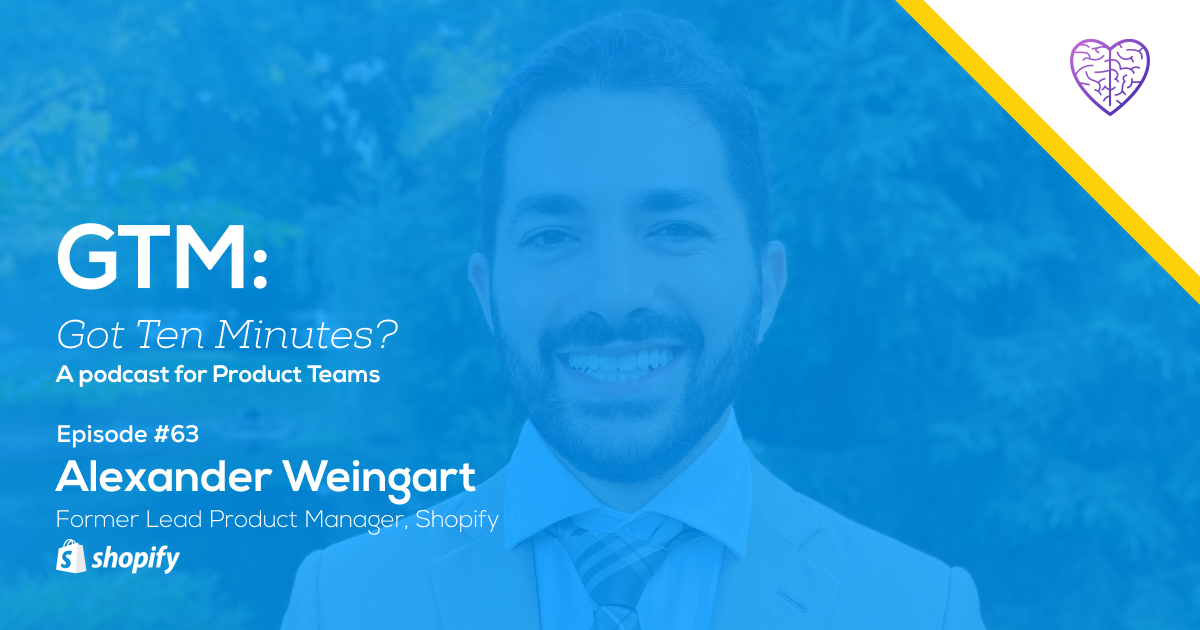
Product strategy is not time reserved for abstract thinking. It is the set of connected choices that keeps execution pointed at the right outcome. In Episode #63, former Shopify Lead Product Manager Alexander Weingart shares how end-to-end ownership, startup failure, selective experimentation, and explicit leadership principles shaped his approach.
What you'll learn
How end-to-end ownership develops strategic and systems thinking
Why subsidized growth can disguise weak product-market fit
How breadth can divide investment across too many users and problems
When an experiment is worth the time and when a team should simply ship
How feedback, autonomy, and vision can guide product leadership
Build strategy by owning the whole experience
Weingart entered product management after a Microsoft internship while studying mechanical engineering. He realized he preferred software but was too far into his degree to switch majors. Product management matched the organizing, delegating, and planning role he often took in group projects. His internship on Windows Phone music and games made the discipline feel like the right fit.
Early at Microsoft, he gained responsibility for a broad overhaul of the music app. Owning an end-to-end experience so early was unusual, and it influenced the roles he pursued afterward. Instead of focusing only on an individual screen or API, he wanted to consider the user's full journey: recognizing a need, finding the product, engaging with it, learning it, and continuing to use it.
That perspective expands into systems thinking. As product leaders become more senior, they need to understand how product interacts with finance, marketing, revenue, and the rest of the business. Strategy is not separate from execution. A useful plan contains structured hypotheses and related bets, then gives the team a basis for deciding what to build and why.
Learn from growth that hid the real signal
Weingart discusses Sosh, a curated events marketplace that eventually closed. He identifies two strategic problems. The first was pursuing growth before engagement or product-market fit. Discounts of 25 or 50 percent encouraged bookings, while a seat-fill program paid merchants even when inventory did not sell. The numbers grew, but that growth depended on subsidies. When funding disappeared, the apparent demand could not sustain the business.
The second problem was breadth over depth. Sosh tried to address restaurants, bars, hikes, concerts, pottery classes, and other city activities even though these represented different needs and business dynamics. Resources were also split across consumer products, merchant products, and internal tools. Weingart believes more attention should have gone to the consumer booking experience because completed bookings created the value merchants needed.
His personal lesson was to speak sooner. He recognized the strategic problems within months but, as a newer PM, did not bring them directly to the executive team. The result taught him to be vocal when he believes a company is heading in the wrong direction, even when raising the concern may not change the outcome.
Experiment only when it improves the decision
Weingart takes a deliberately selective view of experimentation. Established patterns can make some A/B tests unnecessary. Authentication is his example: strong models already exist, so a team may be better served by adapting a proven pattern and shipping it. Smaller products may also lack enough users to reach a useful signal quickly. Waiting a month for an underpowered result can cost more than making a reasoned decision and observing what happens.
Before choosing an experiment, ask whether the change is risky, whether the audience is large enough, and whether competitive examples already answer much of the question. Alternatives include user research, surveys, or a chronological comparison after release.
If an experiment is justified, define the primary metric, hypothesis, counter-metrics, and decision rules before results arrive. Neutral results still demand a choice. A team might keep a neutral change if it simplifies the code or improves user value not captured by the metric, but reject it if it adds maintenance cost. Analytics and logging must also be validated before launch so the test can measure what it claims to measure.
Lead with explicit operating principles
For team leadership, Weingart describes his approach as feedback, autonomy, and vision. Feedback should be candid and bidirectional. Autonomy grows as people gain context, with the long-term goal that they can make as many decisions as possible without the manager. Vision is where the product leader adds context, connecting individual work to the wider product and business.
He also asks leaders to consider the trade-offs among autonomy, collaboration, and speed. Consensus can take longer, while rapid decisions may reduce collaboration. Yet too little autonomy can slow execution because management becomes involved in every choice. There is no universal balance, but managers and candidates should be honest about the environment they are creating or joining.
Listen to the episode:
Listen to Episode #63 for Alexander Weingart's detailed lessons on product focus, honest growth signals, fit-for-purpose experiments, and leadership that makes decision rights clear.
Continue with the workflow pages
Use the ideas from this episode inside the selector, Playwright, and bug-reproduction pages that connect content to product intent.
 Install the Chrome Extension