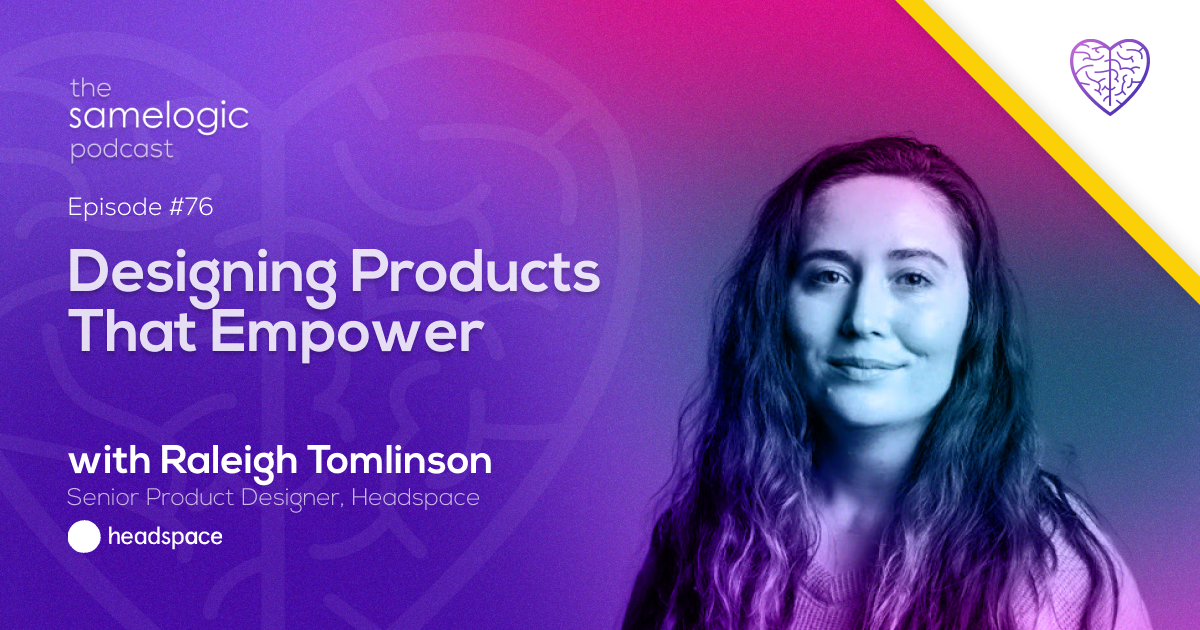
Episode #76: Designing Products That Empower with Raleigh Tomlinson
Raleigh Tomlinson explains how protected deep work, research, meditation, and technology-aware design support focused and useful product decisions.

Raleigh Tomlinson's route into UX began with a longstanding interest in how people work. They studied biology to understand healing, but felt that examining cells and physiology left part of the human picture unexplored. After university, Raleigh spent roughly two years traveling through places including Nepal, India, and Sri Lanka, teaching English and living on a small budget.
A volunteer resident-artist experience at a Sri Lankan surf hostel gave the search a clearer direction. Transforming white walls with murals made Raleigh recognize how meaningful it felt to create something that had not existed before. Back in the United States, they completed a UX bootcamp in 2019 and found an initial contract that same month. UX joined observation and empathy with the practical act of making new products.
Freelance work let Raleigh participate across the product process, from speaking with users to working directly with founders and executive teams. A portfolio of health-related projects eventually matched an early Headspace Health role designing a portal for coaches and guides. The opportunity also fit a personal connection to meditation and a desire to build products that leave people feeling better after using them.
What you'll learn
How Raleigh protects morning time for research, design, and writing
Why meditation can help a contributor choose where to place attention
How early user research can reduce wasted engineering cycles
Why AI products require designers to plan for branching journeys
How a short timer can lower the barrier to beginning difficult work
Protect attention before the day becomes reactive
Raleigh starts the workday by writing down goals rather than immediately opening Slack and email. Weekly opening and closing reflections provide another way to see what was accomplished. This routine guards against spending the whole day in shallow work while messages and discussion threads keep multiplying.
Morning is Raleigh's strongest period for deep work, which may include research, Figma design, a strategy document, a deck, or a write-up of findings. When a task feels intimidating, Raleigh sets a small tomato timer for 20 minutes. The commitment is not to finish the entire project, only to begin and remain with it for that interval. Once the work is moving, continuing becomes easier.
Meditation supports the same goal. Raleigh describes attention as a choice among many simultaneous thoughts and requests. Pausing helps them notice those competing loops and decide what deserves the limited time available. Within Headspace's product triad of product designer, product manager, and engineering manager, that clarity helps Raleigh meet individual-contributor responsibilities without blocking colleagues.
Research before committing engineering effort
Raleigh warns that teams can easily run with assumptions from their own thinking or from leadership. In an experiment-centered culture, many tests will not produce a meaningful metric lift. Research reduces ambiguity before a team spends one of its limited opportunities to build and run an experiment.
Testing an idea with one or two people before involving a full engineering team can prevent avoidable technical debt and shorten the learning cycle. It does not guarantee a winning concept, but it gives the team a more informed reason to make the investment. For Raleigh, research and validation are therefore tools for selecting higher-impact work, not ceremonial stages in a process.
Design AI as a branching experience
At an Artificial General Intelligence House hackathon, Raleigh joined engineers who had created an AI music tool that worked through Discord but lacked a usable front end. The team discussed who might use it, how experienced those people were, and what they wanted to accomplish. Raleigh designed a project structure and stepped song builder that could preserve the parent idea while generated options branched from it.
The exercise exposed a central AI design challenge: the journey is dynamic rather than linear. A model can respond in unexpected ways, so a conventional fixed flow is not enough. Raleigh believes designers should become avid, fast learners who explore new tools while still grounding use cases in human needs. Technology can open the possibility space, but research and design help narrow it into something people can understand and use.
Listen to Raleigh Tomlinson discuss deep work, meditation, research, and designing for AI in the complete episode: Listen to Episode #76.
Continue with the workflow pages
Use the ideas from this episode inside the selector, Playwright, and bug-reproduction pages that connect content to product intent.
 Install the Chrome Extension