Episode #80: Designing for Sales Teams with Alissa Marr
Alissa Marr explains how research, familiar patterns, paper sketches, transparent AI flows, and rapid iteration can improve sales software UX.

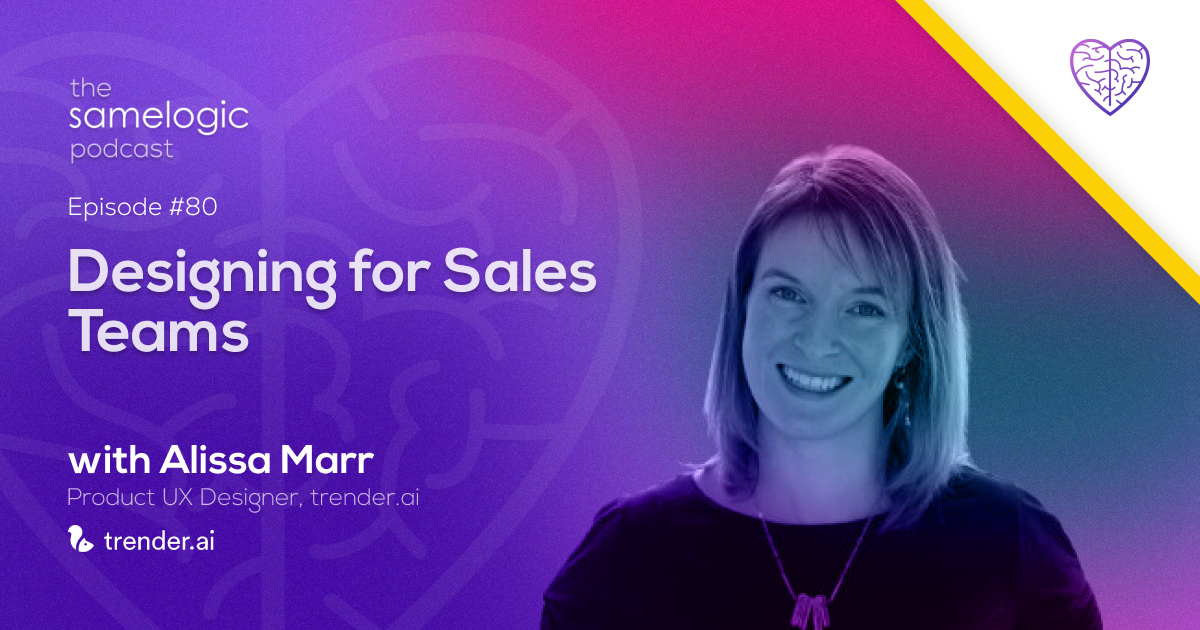
Alissa Marr brought a research-heavy graphic design background into user experience design. While working in fashion and ecommerce, she tracked visual trends, studied generational behavior, and examined buyer intent. Those habits transferred naturally into competitive research and user conversations. Her career changed direction after a fashion role did not provide the work environment she wanted. She had previously taken a one-day UX course, then later used a bootcamp to add UX methods to her bachelor's education in design art and graphic design.
At Trender.ai, Alissa works as the sole product designer on a team of roughly six people. The company pivoted toward software for sales professionals, which required her to learn a new audience while the product and team continued moving quickly. She discovered that many salespeople work under intense quota pressure and rely on prospecting processes that include cold calling, web searches, and information spread across different tools. That context changes the standard for usability. Every unnecessary step consumes time that could be spent building relationships with prospects.
What you'll learn
How a graphic design research practice can transfer into UX work
Why familiar patterns can reduce the learning burden in a new product
How paper sketching helps Alissa connect requirements before opening a design tool
Why AI products need visible explanations of background processes
How a solo designer contributes to scope and quality in a small startup
Borrow familiarity, then simplify the workflow
Alissa does not begin every interaction from a blank canvas. She studies the products her users already use and identifies patterns that can make Trender feel familiar. Because sales professionals often work in HubSpot, she considers relevant patterns from that environment when designing Trender. This is a practical way for a small startup to move quickly, but it is not blind copying. She notes that not every pattern fits. The design still has to support Trender's product and the specific job the user is trying to complete.
Understanding the job also means accounting for pressure. Alissa had not fully appreciated how quickly missed quotas could threaten a salesperson's employment. Once she understood that reality, long flows became harder to justify. She often looks at an initial journey and asks how to reduce it to the smallest reasonable set of choices. The broader product aim is to gather useful prospect information while reducing the bandwidth users spend moving among other applications. That creates more time for the human work of developing a good prospect relationship.
The team's small size shapes how research reaches design. Dedicated one-on-one user research is difficult to schedule while Alissa is focused on product delivery. Instead, the team records sales demo calls and gathers feedback from customers and design partners. Product leaders use those signals to weigh improvements to existing tools against new features. Neither option is free of risk, so the team must remain tightly focused on small pieces of work. Alissa combines those inputs with requirements from her manager, competitive research, brainstorming, sketches, and storyboards.
Make the design process visible and adaptable
Paper has become more than a place for Alissa to draw screens. She opens the Jira ticket, writes down pieces of the problem, circles and connects related requirements, and turns the page into a working map. That process helps her identify design needs quickly and think more iteratively than she does while staring at a screen. Only after those relationships are clearer does she move into interface sketches. Storyboards then provide a fast way to communicate how an experience or prototype should behave without polishing every screen first.
This low-fidelity approach works because her manager values speed and clarity over presentation. A useful sketch can be rough or even drawn on a napkin. The purpose is to establish the direction before investing time in visual refinement. That discipline is especially important when deadlines are tight and larger releases are approaching. It also leaves room to change scope when implementation uncovers dependencies that were not obvious in the original ticket.
AI introduces a different communication challenge inside the product. Trender performs processes in the background, but users still need enough information to understand what is happening. Alissa says the team learned that it had to explain more than expected. The interface may use messages or modal windows to guide users, sometimes allowing them to dismiss future reminders. This is a form of product hand-holding, but it supports trust in an unfamiliar workflow rather than assuming that an innovative system is self-explanatory.
Alissa's role as the only product designer also gives her a broad quality responsibility. As requirements evolve, she proposes solutions, flags when scope should change, and identifies work that must happen before another task can proceed. Her visual design background helps her notice small alignment and polish issues that users may feel without being able to name. She reports those defects because seamless fit and finish can keep the interface from calling attention to itself. Her former difficulty with rapid pivots has become a strength: she can reassess the whole system, separate what will make a release from what will not, and keep moving as the startup learns.
Listen to the episode
Hear Alissa's full discussion of her move from graphic design to UX, sales-team research, sketching, AI transparency, startup constraints, and visual polish. Listen to Episode #80.
Continue with the workflow pages
Use the ideas from this episode inside the selector, Playwright, and bug-reproduction pages that connect content to product intent.
 Install the Chrome Extension