Episode #34: Aligning Product Teams Around Customer Evidence with Myra Xiong
Myra Xiong explains how interviews, customer success insights, beta programs, usability tests, and shared goals help product teams align decisions.

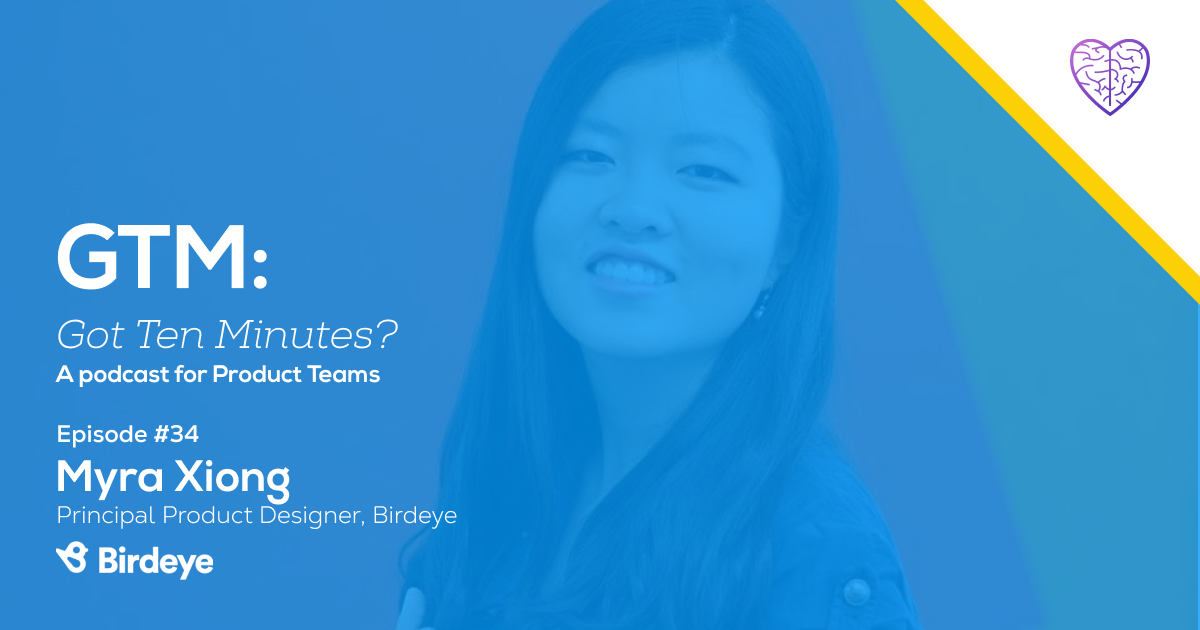
Product alignment is easier when a team can connect opinions to customer evidence and shared goals. In Episode 34, Myra Xiong discusses the research phases, cross-functional work, and self-directed learning that shape her product design practice at Birdeye.
What you'll learn
How cognitive science can inform a designer's way of thinking
Where customer success insights fit alongside direct research
How interviews, beta programs, and usability tests serve different phases
How designers can uncover the goals beneath conflicting feedback
Why self-learning matters for designers without traditional training
Apply an interdisciplinary lens to design
Myra grew up in New York, attended college in California, and stayed in the Bay Area. At Berkeley, she studied cognitive science, an interdisciplinary major that combined areas such as computer science, psychology, sociology, and anthropology to examine human thought and behavior. A student-led web design and development class introduced her to design. She then pursued internships that involved both designing and coding websites before joining Birdeye as an intern.
She is careful not to claim a direct line from every academic concept to an interface decision. Instead, the value lies in the way interdisciplinary study frames a problem. Product design is not only about screens. It includes the relationship between a business and its customers, plus the way an organization works together to create an experience. Concepts such as mental models can help a team consider how users expect a familiar task, like making a payment, to work.
For product teams, that distinction prevents theory from becoming decoration. A principle is useful when it improves the team's understanding of behavior or clarifies a design choice, not when it is attached after the decision to make the work sound rigorous.
Use the right evidence at each phase
Birdeye began with online reputation management for businesses and expanded into a wider set of products supporting customer experience. As a principal product designer, Myra worked cross-functionally on priority projects and planned roadmaps with product managers and engineers. Her role included core areas such as reviews.
She describes multiple validation phases, including idea validation, design direction validation, and final review. The team changes its method based on what it needs to learn. Customer interviews provide direct understanding. Customer success teams add information from their day-to-day relationships with businesses. Beta testing lets the team observe how customers use a new product during staged releases and use that response to guide what comes next. Usability tests in the middle of the process help assess whether a design is discoverable and usable.
The important point is that Myra describes different methods at different phases. Interviews and customer success input help inform direction. Beta phases show how businesses use and respond to new products. Mid-process usability tests check discoverability and usability.
Align feedback through goals and research
Myra identifies cross-team alignment as a recurring challenge. During a design review, feedback may point in different directions. Rather than treating every comment as an isolated preference, she tries to understand where it comes from and what each participant wants the product to achieve.
That shifts the discussion from competing solutions to underlying goals and motivations. Once those are visible, the team can compare them with existing data and research. Some disagreements may dissolve because people share a goal but proposed different paths. Others may expose a real trade-off that requires an explicit decision.
Designers have an active role in this process. They are not only responsible for presenting screens. They can organize the conversation, connect research to the direction, and help engineers and product managers see where their concerns overlap. Alignment does not mean removing healthy disagreement. It means giving the group a shared basis for deciding.
Turn a nontraditional path into a learning system
Myra did not begin with a traditional design education and initially did not understand the distinction between web design and product design. Conversations with working product designers helped her identify what she needed to improve. She came to view self-learning as a strength.
That strength became concrete when she led the creation of two iterations of Birdeye's design system. She learned what the work required and passed that knowledge to others. Her growth also took place alongside the team itself. Birdeye's design organization expanded from roughly three product designers to eight, with additional people on the growth side, and she found mentoring other designers rewarding.
A nontraditional background does not remove the need for craft. It makes the learning process more visible. Teams can support that process by encouraging questions, sharing acquired knowledge, and giving designers opportunities to teach what they have learned. Mentoring then becomes part of how the organization retains and compounds expertise.
Episode 34 provides a focused account of evidence-led design and cross-functional alignment. Listen to the full conversation for Myra's perspective on mental models, phased validation, mentoring, and learning into larger design responsibilities.
Continue with the workflow pages
Use the ideas from this episode inside the selector, Playwright, and bug-reproduction pages that connect content to product intent.
 Install the Chrome Extension