20 Jev Use Cases That Hold Up Under Scrutiny
Explore 20 evidence-backed Jev use cases across browsers, coding agents, search, support, databases, media, and constrained interfaces.


TL;DR: Jev is most useful when software already knows the allowed outputs and needs a fast semantic decision: choose an action, score a candidate, decide whether something fits, or route uncertain cases to a person. The strongest public examples are not open-ended chatbots. They are bounded decision layers inside browsers, coding agents, search systems, support workflows, databases, media tools, and constrained user interfaces. We reviewed public products, repositories, first-party cookbooks, X posts, and Reddit discussions, then ranked the 20 use cases below by Jev-native fit, evidence strength, operational value, measurability, and how safely errors can be contained.
What Jev actually does
Jev is a decision model, not a prose generator. The surrounding application supplies state and asks bounded questions. Jev returns typed probabilities through primitives such as a Choice, a Score, or a Noul: TypeSafe’s yes/no-style probabilistic judgment. The application still owns permissions, execution, validation, thresholds, and deterministic operations.
That distinction explains why many convincing Jev projects have the same shape:
Ordinary software gathers the current state.
Jev makes one or more semantic judgments.
Code applies thresholds and safety rules.
A browser, agent, database, or interface performs the permitted action.
Low-confidence or high-consequence cases go to a person.
The TypeSafe launch explanation describes this as machine-facing intelligence built around typed decisions rather than token-by-token generated text.
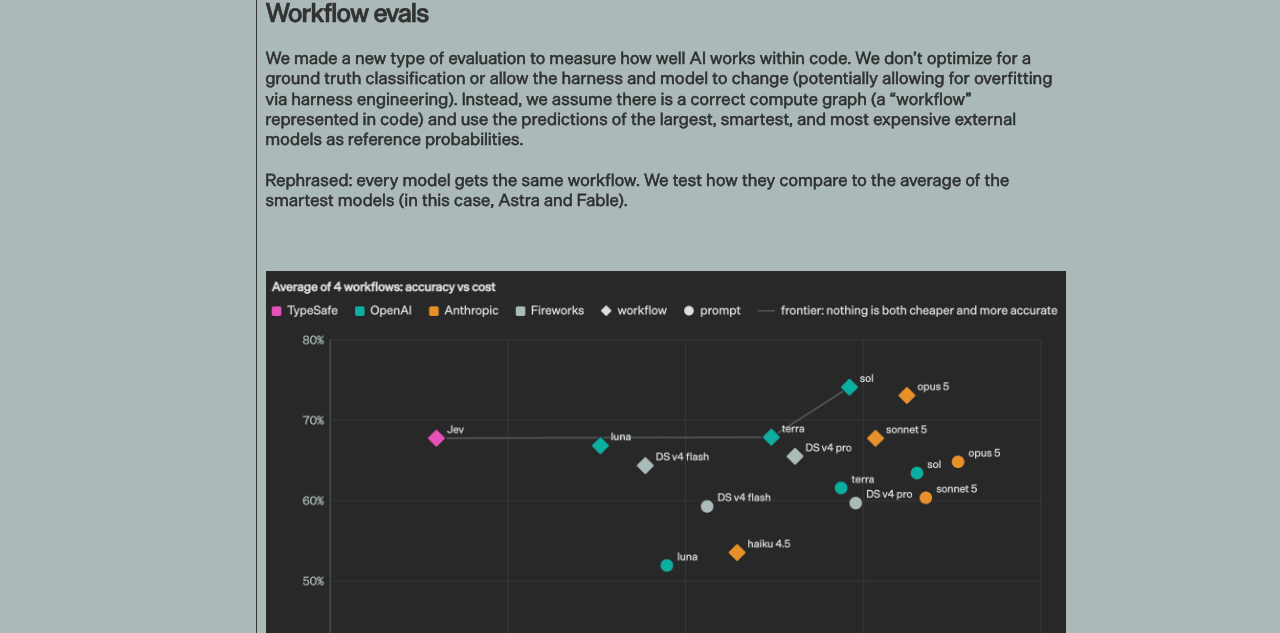
How we ranked these use cases
We did not rank projects by likes, novelty, or how dramatic the demo looked. Each use case was assessed on six factors:
Jev-native fit: Is the core task a bounded semantic decision?
Evidence: Is there a public implementation, demo, repository, evaluation, or reproducible cookbook?
Operational value: Does the decision happen frequently enough for latency, consistency, or cost to matter?
Measurability: Can teams compare the output with human labels or real workflow outcomes?
Deployability: Can mistakes be contained with code, thresholds, or human review?
Distinctiveness: Is this a genuinely different decision pattern rather than the same classifier in another industry?
A demonstration proves feasibility. It does not prove broad accuracy, return on investment, or safe autonomy.
1. Browser action selection
Browser agents repeatedly face a bounded question: given the current DOM or accessibility tree, which permitted action should happen next, and which element should receive it? That is unusually close to Jev’s intended shape.
Browser Use’s open-source Jev Ultrafast sends the visible browser state and allowed operations to Jev. Jev selects the operation and target. A small generative model is used only when the browser needs text to type. The project’s Google Flights demo reports a Zurich-to-London search in roughly seven seconds; this is a builder-reported demonstration, not a general browser benchmark.

Browser Use’s Jev experiment lets the decision model choose each browser action and DOM target while a small language model handles typed text.
Source: Gregor Zunic on X
Why it fits: the browser supplies a finite action set; code remains responsible for execution, waits, navigation state, and permissions.
2. Mobile interface automation
Mobile automation has the same decision structure as browser automation, but the available state comes from the device UI tree. The mobile-jev project demonstrates Jev choosing actions against a real Android phone while the mobile automation layer performs them.
The compelling pattern is not “Jev can use any phone.” It is narrower: Jev can help choose among currently available UI actions when another system has already exposed the screen state, valid targets, and execution tools.
Best use: repeatable mobile test flows, guided device operations, and agent experiments where every action remains observable and interruptible.
3. Coding-agent context compaction
Long coding sessions accumulate tool output, file reads, logs, and intermediate results. A conventional summary rewrites the retained context and can damage exact paths, commands, and errors. A filtering approach asks a different question: which original blocks are still relevant?
fast-jev-compaction uses Jev to score old tool calls and outputs, then removes material judged irrelevant while preserving kept text verbatim. Its public demo reported reducing a session near one million tokens to roughly 86,000 in about a second. That number is project-reported and workload-specific.
Instead of asking another model to rewrite a long coding-agent context, this experiment used Jev to decide which original tool calls and results should remain.
Source: Tamara Tran on X
Why it fits: relevance is a bounded judgment, while the sensitive exact text can remain untouched.
4. Guardrails for risky agent actions
A coding agent can produce a technically valid command that does not match the user’s intent, or declare a task complete without evidence. The valuable layer is not another free-form lecture. It is a fast hold, allow, challenge, or escalate decision before the action runs.
pi-warden places a Jev-backed review layer around coding-agent actions and completion claims. Its maintainers report 743 sessions, 193 risky actions held before execution, and 1,292 notes sent back to the agent during nine days of use. These are author-reported operating numbers, not independently audited safety results.
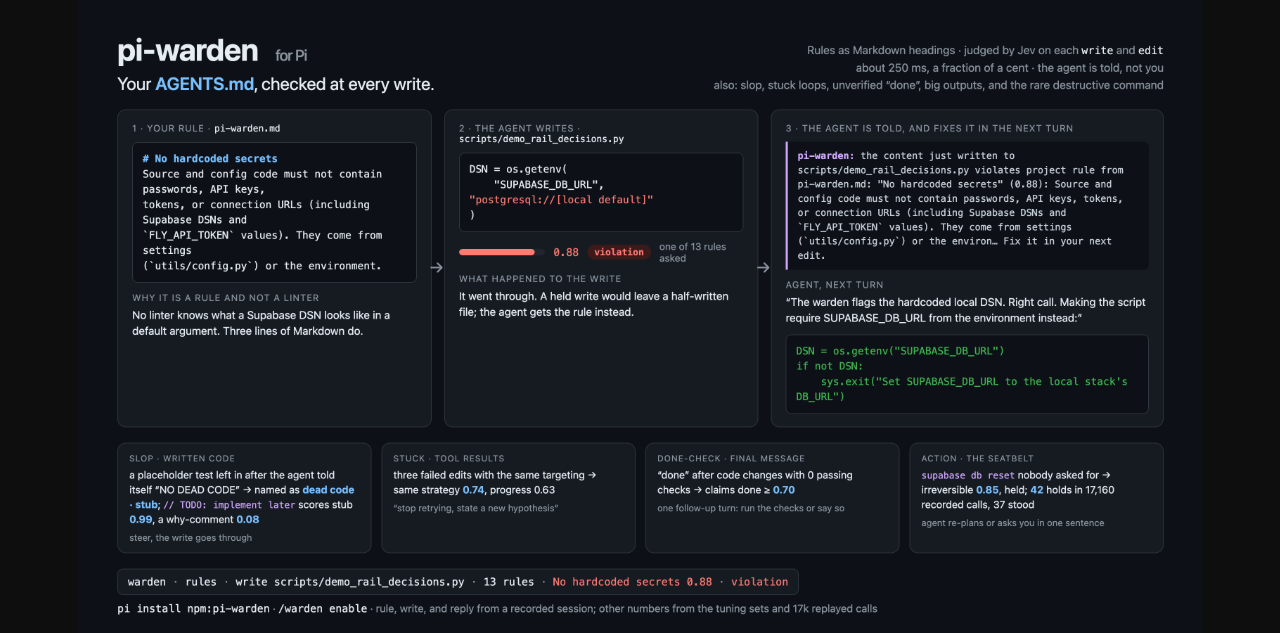
Why it fits: applications can combine a semantic risk judgment with hard deterministic blocks, allowlists, and human approval.
5. Per-turn model routing
Many requests do not need the same model. A router can classify difficulty, domain, latency sensitivity, or risk, then send the turn to a suitable model tier.
The Jev Router project exposes Jev-backed routing inside Claude Code and OpenAI Codex workflows. Jev decides where a turn should go; the selected coding model still performs the work.
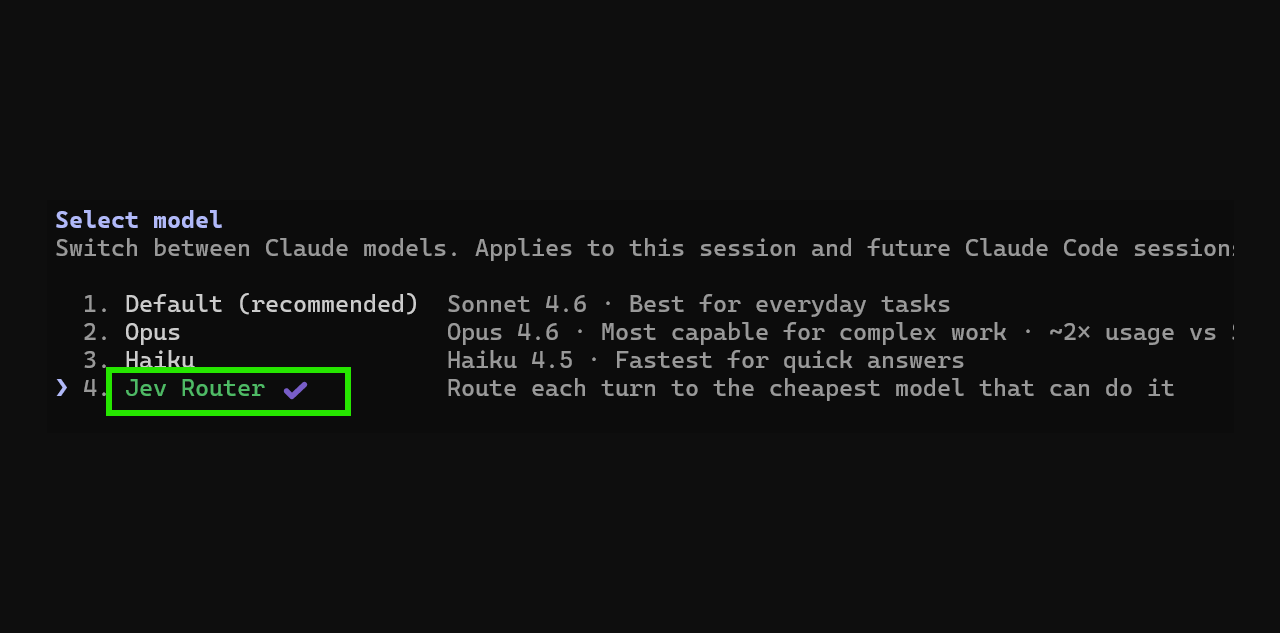
Why it fits: routing is a constrained choice with measurable downstream cost, latency, and success. The savings claim must still be tested against each team’s actual workload.
6. Agent and LLM evaluation
Evaluation systems often need thousands of repeated semantic judgments: did the agent follow the instruction, choose an appropriate tool, finish the task, or violate a rule?
A LangChain experiment ran Jev on five fixed weather-agent traces repeated 100 times. The team reported agreement with human binary labels on all 500 judgments, an average response around 0.44 seconds, and lower score variance than the compared LLM judges. The sample was intentionally narrow, so it supports the pattern—not a universal evaluator claim.
OpenRouter also reported a Jev judge test through Ori Eval, emphasizing latency. Both examples show why evaluation is promising: the rubric can be explicit, ground truth can be collected, and disagreement can be routed to people.
7. Tool and function selection
An application may already know every legal function. The semantic task is to choose one and extract or verify bounded arguments—not invent arbitrary code.
Jev Chat demonstrates a chat-shaped command interface where Jev classifies what the user wants and selects the appropriate tool. The surrounding application supplies the functions and executes them.

Why it fits: the valid options are known in advance. Permissions, schemas, argument checks, and side effects stay in ordinary code.
8. Search-source selection and result reranking
Search quality involves several small decisions: which sources should be queried, what time window matters, which search terms should be used, and which returned candidates are most relevant.
Jev Search demonstrates this pattern in a public interface. It presents itself as a search system that chooses where to search and ranks what comes back, without generating a synthetic answer.

TypeSafe’s reranking cookbook also documents query–candidate scoring after an initial retrieval stage. Its reported legal-retrieval result is first-party evaluation evidence, not an independent benchmark.
Why it fits: retrieval produces candidates; Jev scores semantic fit; code sorts and applies thresholds.
9. RAG passage gating
RAG systems often pass every retrieved chunk into a generative model even when some passages are irrelevant, contradictory, or contain injected instructions. A better gate asks several independent questions before construction of the final prompt.
TypeSafe’s RAG passage-classification cookbook evaluates relevance, answer evidence, contradiction, and prompt-injection risk, then routes each passage in code. The example makes the important architectural point: the threshold logic is explicit and can be changed without paying to reclassify stored answers.
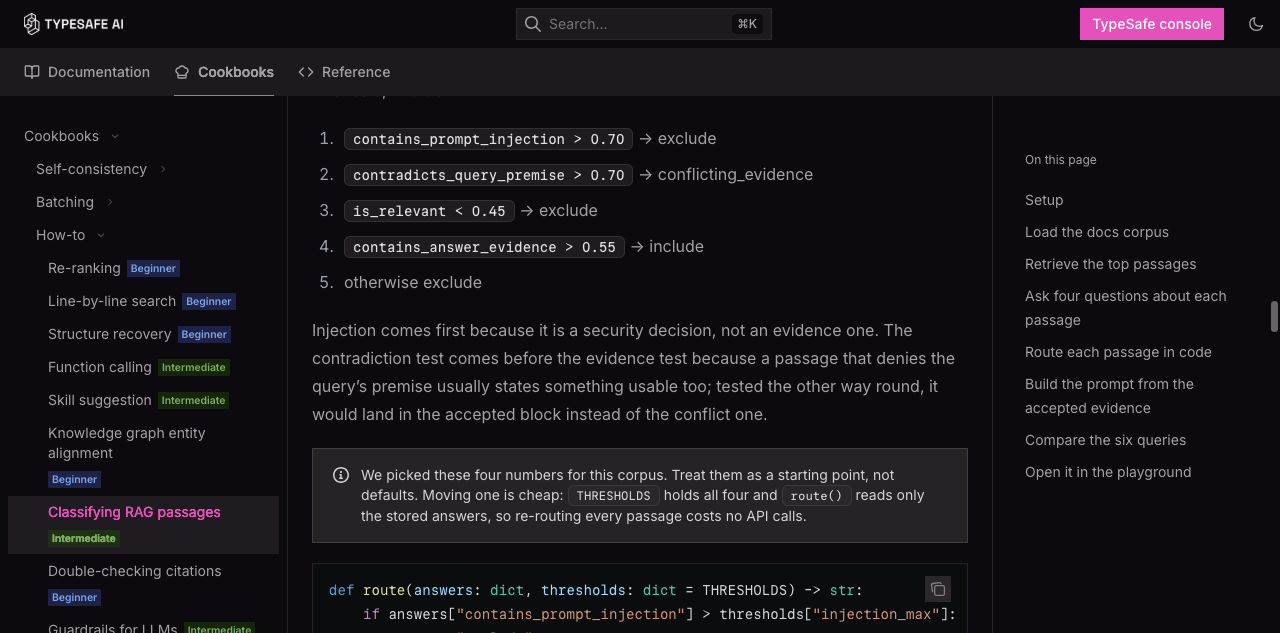
Why it fits: passage admission is a bounded set of semantic checks, while prompt construction and conflict handling remain deterministic.
10. Citation and claim verification
A citation checker can compare a supplied claim with supplied evidence and return a small state such as supported, contradicted, insufficient, or fabricated.
TypeSafe’s citation-checking cookbook demonstrates this workflow and reports catching four planted failures in an eight-citation example. Eight citations is far too small to establish general accuracy, but the task structure is strong: the source text is available, the output classes are bounded, and humans can inspect disagreements.
Best use: a first-pass verifier before publication, audit, or human review—not an automatic declaration of truth.
11. Code review and risk prioritization
A code-review assistant can inspect a diff or repository and classify findings by risk, confidence, and the reviewer best positioned to investigate. It should not pretend that a semantic model replaces tests, static analysis, or human review.
Jev Review provides a local dashboard for reviewing Git diffs or complete codebases and organizing findings into a structured queue.

Why it fits: the high-value decision is prioritization and routing. Compilation, tests, type checking, and deterministic security scanners remain separate evidence.
12. Semantic filtering inside a database
Traditional SQL is exact. Many useful business rules are not: “show support cases that sound unresolved,” “rank product feedback by relevance to this roadmap item,” or “classify these records against our current taxonomy.”
The pg-jev PostgreSQL extension exposes semantic filtering, ranking, and classification against database rows using natural-language conditions.
Why it fits: SQL narrows and structures the dataset; Jev evaluates the semantic condition; database logic retains control over limits, permissions, and writes.
Related pattern: jev-semgrep applies a similar idea to text lines and code search, using semantic questions where a regular expression is too rigid.
13. Email and customer-support triage
Inbox and support queues contain repeated bounded decisions: category, urgency, department, frustration, spam, whether a reply is needed, and whether a person should take over.
TypeSafe’s public customer-service evaluation shows synthetic workflows for refund, fraud, retention, and escalation decisions. Separately, Jevmail implements read-only Gmail triage, and a public builder discussion described scoring 1,700 emails for category, priority, spam, and reply need.
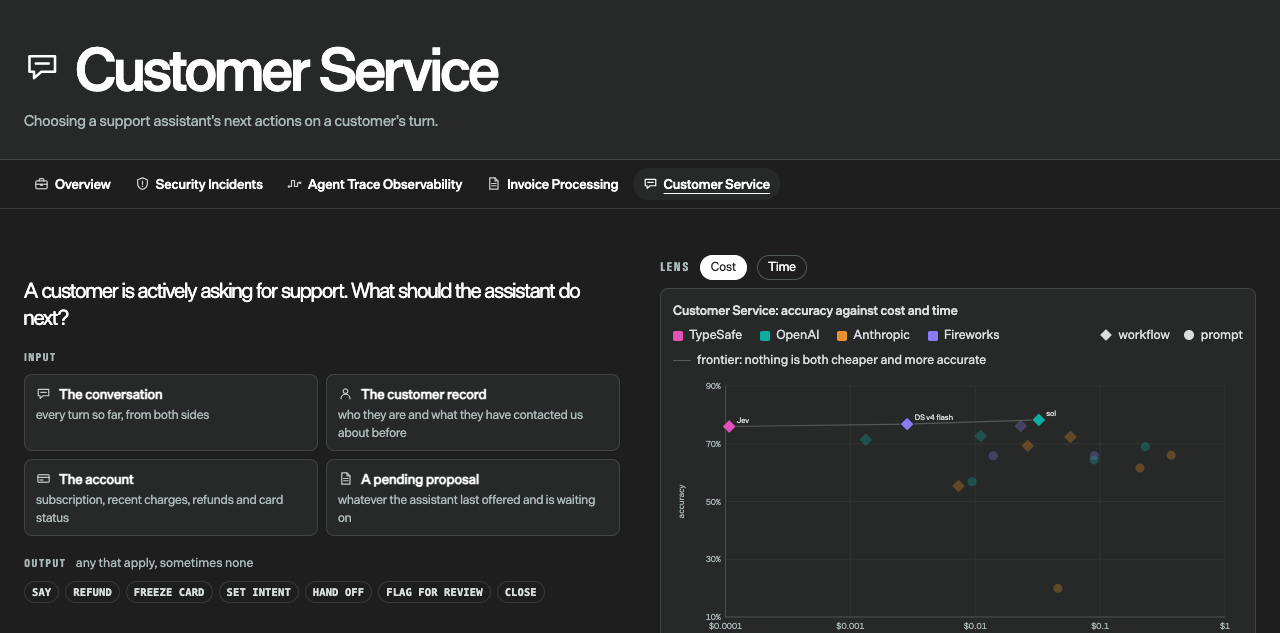
Why it fits: multiple independent labels can be computed in one bounded call, while the mail or support system applies routing and human-approval rules.
14. Feed filtering and sponsor detection
Content filtering works when the model is asked a specific question against a defined policy: is this element an advertisement, is this post relevant, or is this transcript segment a sponsor read?
Sponsor Skip uses Jev to identify sponsor segments and provides a browser-extension panel and web interface.
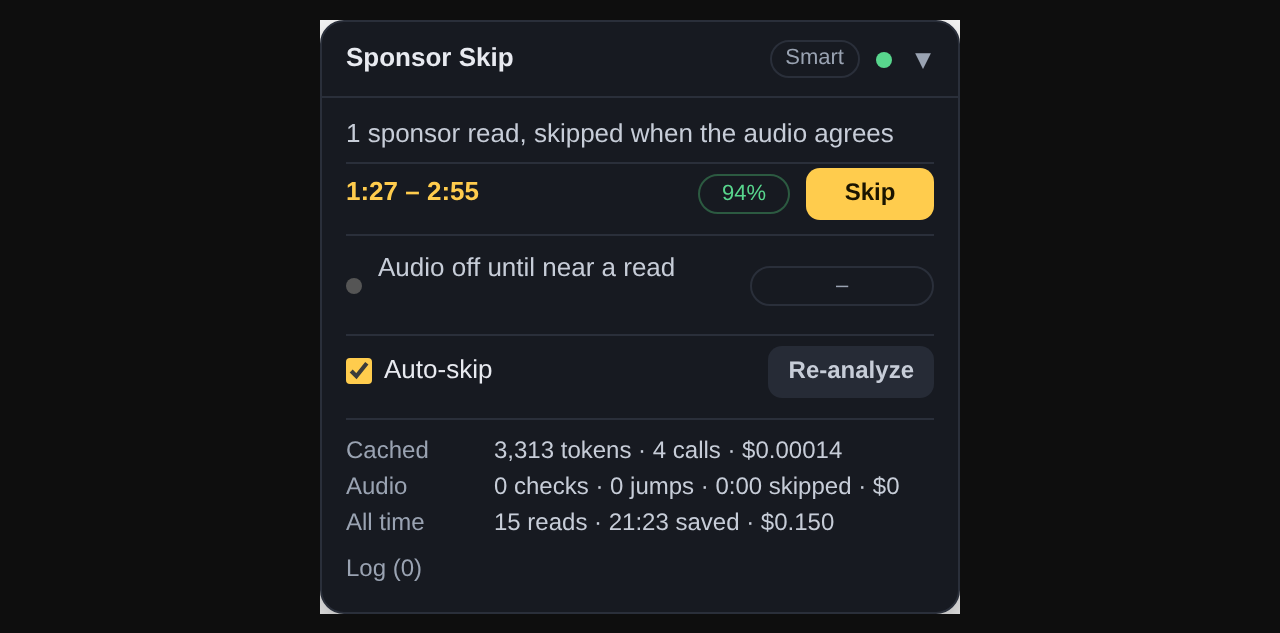
A separate builder demonstrated real-time classification of X posts as a user scrolled. TypeSafe Fun AdBlocker provides another explicit toy implementation, but its own repository warns that it is a side project rather than a production ad blocker.
Why it fits: the policy can be stated directly and uncertain items can remain visible or go to review.
15. Advertising and creative classification
Marketing teams repeatedly classify ads by hook, format, offer, call to action, awareness stage, and landing-page fit. Those are rubric judgments, not open-ended copywriting.
A public Steal Ads experiment reported analyzing 724 live ads from 37 brands in about 40 seconds for $0.09. The figures are builder-reported, and a taxonomy score should not be confused with predicting campaign performance.
Why it fits: a stable taxonomy can be applied across a large batch, then compared with human labels and campaign outcomes.
16. Research and document screening
Researchers and editorial teams often need a first-pass screen against explicit inclusion criteria. The model can score relevance, evidence quality, topic fit, or whether a document requires deeper review.
Public examples include research-paper screening and a Japanese publishing experiment that classified 1,852 articles. The latter reported strong precision on a binary task but much weaker agreement on a nine-way taxonomy—a useful reminder that success on one label structure does not transfer automatically to another.
A Reddit ecosystem review also captured the broader pattern clearly: Jev projects usually ask small questions such as “Which action?”, “Which file?”, “Keep or drop?”, or “Safe or unsafe?” rather than asking Jev to produce the finished work.
Reddit discussion: I reviewed 287 open-source Jev projects. Here are 20 that actually helped me understand what Jev is good at
By u/chenrongwei in r/LLMDevs
Best use: reduce the human reading queue, while preserving source documents and exposing uncertainty.
17. Smart-home state and automation decisions
A smart-home system already has deterministic device controls. The semantic layer needs to interpret questions about the house, evaluate current state, and choose which permitted automation should run.
The Jev for Home Assistant integration turns Jev questions into Home Assistant entities and automation inputs.

Why it fits: devices, permissions, and actions are explicit. The model can answer bounded questions while Home Assistant remains the execution and safety layer.
18. Training-data filtering
Large JSONL or Parquet datasets contain examples that satisfy or violate qualitative rubrics. A fast semantic filter can reduce the corpus before expensive training or human inspection.
The jev-curate project applies Jev judgments to high-throughput dataset filtering and publishes project-reported measured runs and presets for reasoning, anti-sycophancy, and code correctness.
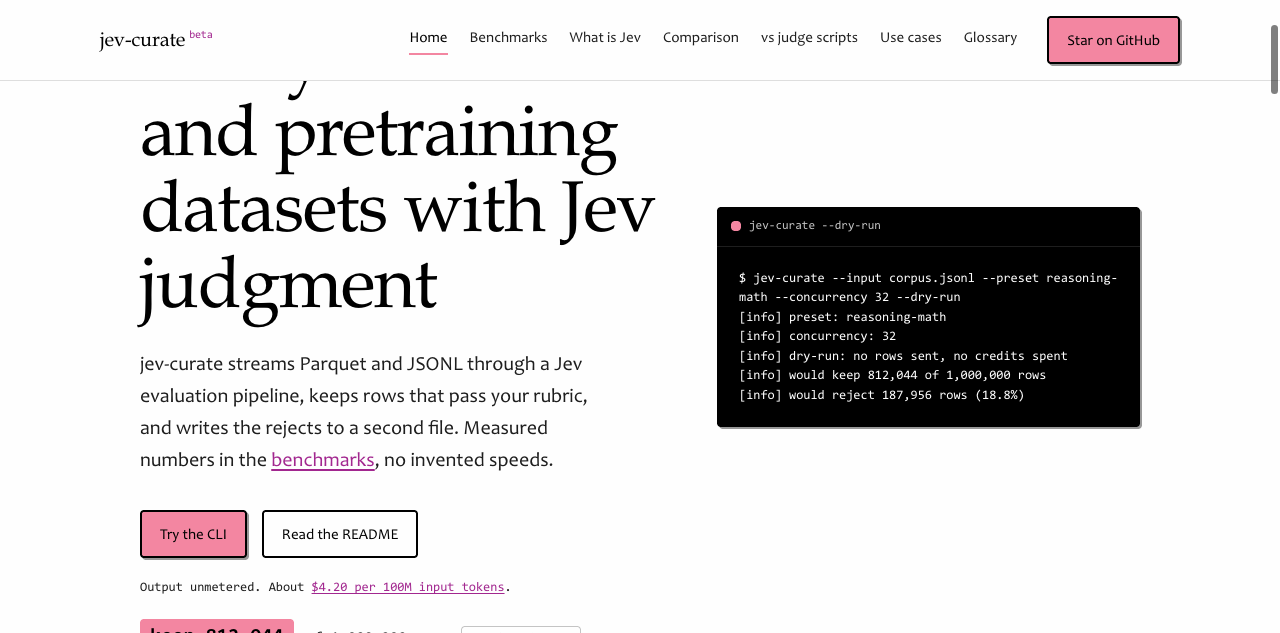
Why it fits: the rubric can be explicit, every row keeps its source identity, and sampled human review can estimate false keeps and false rejections.
19. Scoring speech and video transcripts
Jev is text-based, so media workflows require another system to produce the transcript, captions, or structured observations first. Once that state exists, Jev can score each segment against a fixed rubric.
jevmeter scores transcript sentences for characteristics such as factual claims, evasiveness, contradiction, emotional appeal, and question dodging, then renders a visual meter. Its political-debate example is a project-authored demonstration; the displayed scores are model judgments, not verified facts.
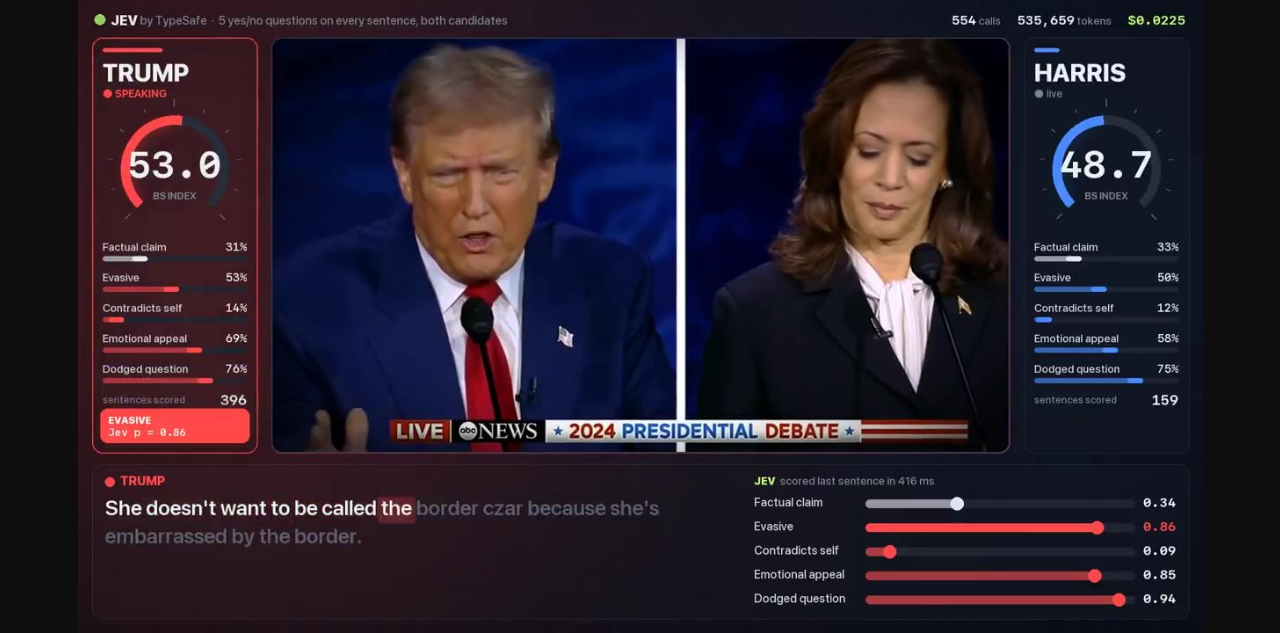
Why it fits: each transcript segment receives the same bounded questions, while the media pipeline handles transcription, speaker timing, and rendering.
20. Bounded generative UI composition
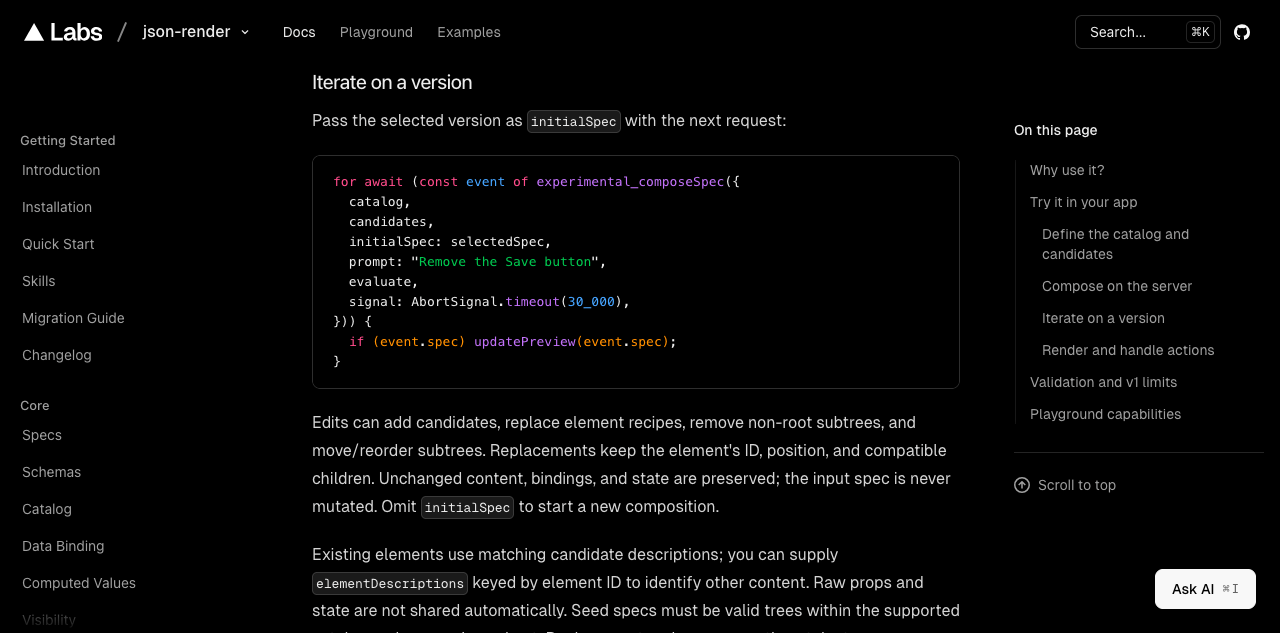
“Generative UI” does not have to mean generating an unconstrained interface specification token by token. If the application provides a catalog of approved components, Jev can select components, properties, and layout choices while code assembles the interface.
Vercel Labs’ json-render Jev experiment documents this constrained composition pattern. The documentation labels it experimental, which is the correct framing.
JevHarness explores a related pattern: a larger model authors a task-specific harness, then Jev handles repeated bounded decisions inside that harness.

Why it fits: the allowed building blocks and properties are controlled. The system can validate the assembled result before rendering it.
Three patterns that matter more than the individual demos
Jev is strongest as a layer, not the whole application
Browsers still need browser automation. Databases still need SQL. Coding agents still need an actual coding model. Video tools still need transcription. Jev’s role is the frequent semantic decision between state collection and execution.
Typed output prevents invalid shapes, not wrong valid answers
A model that must return one of four choices cannot invent a fifth schema value. It can still confidently choose the wrong allowed answer. The skeptical Reddit discussion is useful here: teams should compare Jev with strong classifiers, rerankers, and fine-tuned local models—not only with slower generative LLM judges.
A separate public benchmark discussion reported that a fine-tuned classifier remained stronger and faster when substantial labeled data already existed, while Jev was attractive when labels were unavailable, changing, or needed quickly.
Reddit discussion: I benchmarked TypeSafe's JEV against LLMs, BERT and Laya
The best deployments have an uncertainty path
A production workflow should not force a decision when no option fits. It should support abstention, confidence thresholds, review queues, deterministic rules, and a record of why the action was taken.
Where Jev is the wrong tool
The current evidence does not justify treating Jev as the final autonomous authority for:
moving real money or making investment decisions;
clinical or radiology decisions;
hiring acceptance or rejection;
fraud determinations without investigation;
safety-critical robotics, drone, or vehicle control;
predicting conversion, churn, virality, or market movement without prospective outcome validation;
exact arithmetic, date comparison, counting, or deterministic validation;
writing, summarization, or open-ended conversation.
Trading, driving, Minecraft, Doom, and drone demos are useful evidence that Jev can make fast bounded choices. They are not evidence that it can safely control consequential systems without hard constraints and independent validation.
A practical test for your own Jev idea
Before adding Jev to a workflow, answer five questions:
Can you enumerate the legal outputs? If not, the task may need a generative model or a redesigned interface.
Can ordinary code perform the final action? Jev should decide; deterministic software should validate and execute.
Can you collect labels or outcomes? Without a feedback set, confidence is difficult to calibrate.
What happens when confidence is low? Define abstention and human review before launch.
What is the cheapest credible baseline? Compare with rules, embeddings, rerankers, conventional classifiers, and fine-tuned local models.
The most promising Jev project is rarely “replace the entire agent.” It is usually one expensive, repeated semantic decision that can be made bounded, measured, and reversible.
Sources and project index
Most Jev ecosystem projects were created shortly after the model’s September 2026 launch. Project-reported cost, speed, accuracy, and usage figures should be reproduced against your own data before they influence a production decision.
Related workflows
Move from editorial context into the selector, Playwright, and bug-reproduction pages that turn exact UI evidence into action.
 Install the Chrome Extension